
My eBook
Categories
-
Recent Posts
September 2026 M T W T F S S 1 2 3 4 5 6 7 8 9 10 11 12 13 14 15 16 17 18 19 20 21 22 23 24 25 26 27 28 29 30
Wimbledon – round 2nd
Longest match: 4 hours, 13 minutes. Mardy Fish d. James Ward 6-3, 5-7, 6-4, 6-7, 6-3
US Open 2011: A.Falla 6-3, 3-6, 6-4, 5-7, 5-7 – 3 m.p.
Australian Open 2010, 1R: Mayer d. Petzschner 0-6, 2-6, 6-4, 6-2, 6-2
Posted in Tournaments
1 Comment
Wimbledon – round 1st
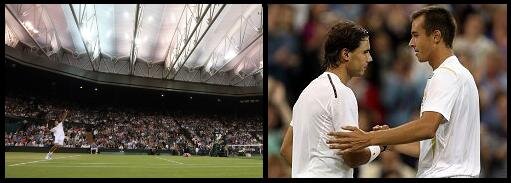
The draw is stronger than in Paris, Mardy Fish and Kei Nishikori return to the action with first round wins after a month break. Just like in Paris, Gael Monfils withdrew after the draw had been made (replaced by a ‘lucky loser’ Wayne Odesnik). Before the start of the tournament there was one serious question – is anyone able to eliminate at least one of the two best players before the final? If Rafael Nadal and Novak Djokovic played another major final, we would say that men’s tennis becomes more and more boring and predictable. Anyway, “the big four” moved through to the second round comfortably (Djokovic, Nadal and Andy Murray on Centre Court, Roger Federer on Court No. 1), albeit Rafa notched a false start 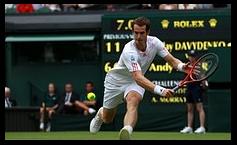 against Thomaz Bellucci. The Brazilian led 4:0 (30/15) on serve in the 1st set when missed a relatively easy high-backhand volley. Since that moment it was a one way traffic, Nadal won 7-6(0) 6-2 6-3 in 2 hours 15 minutes, Djokovic needed only 98 minutes to dismiss Juan Carlos Ferrero, Federer 19 minutes less to got a 3x 6-1 win over Albert Ramos. Each of the three best players in the world finished his match with an ace (Djokovic displayed unusually solid service performance hitting 13 aces). Also Murray was on his way to deliver a triple “bread-stick” but met some resistance from Nikolay Davydenko in the 3rd set (the Brit won 6-1 6-1 6-4). “It was a good start, and I knew obviously when I drew him I was going to need to start the tournament well, playing good tennis,” said Murray improving his H2H against the Russian to 6-4. “I struck the ball well. It’s been a long couple of weeks since Queen’s. Once I got ahead, I wanted to make sure I didn’t let him back in. He’s very, very dangerous. He’s a very good returner as well.” In some sense the first round at Wimbledon ’12 ends up some period in men’s tennis, the best players of the 00’s are hopeless in confrontation with younger guys, such notable guys of that era like Ferrero and Davydenko couldn’t do anything as well as the former champion (2002) Lleyton Hewitt, who was ousted in three sets by Jo-Wilfried Tsonga.
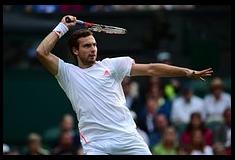 Ernests Gulbis [87] still remains a mystery. The Latvian has had an abysmal season which forced him to play two Challengers where he couldn’t even get quarterfinals. And all of a sudden he enters the Centre Court at the most prestigious tennis event in the world, and plays arguably the match of his life overcoming Tomas Berdych [7] in three tie-breakers. Gulbis presented a new technique at the forehand (more flick of the wrist) and perhaps it was the key because in each tie-break he made decisive mini-breaks producing forehand winners DTL. His serve was working excellently – 30 aces at 72% 1st serve in; he added 62 winners! Even wasting a double break point in the crucial stage of the 3rd set, and precocious celebration of the third match point (10th game) didn’t interrupt his focus. It was Berdych’s first opening round loss at Wimbledon since his debut in 2004; the Czech has lost his tie-break magic: 29-10 record at one stage, taking into account a year and a half, 0-7 in the last two months! Berdych wasn’t the only seeded victim in the opening day – on Court No. 3 John Isner squandered a match point leading 7:6 in the 4th set tie-break and lost to [73] Alejandro Falla 4-6 7-6(7) 6-3 6-7(7) 5-7. “I had my chances,” said Isner. “It’s all on me. Was just not great on my part. I felt fine coming into here. It’s just now I get out there sometimes, and lately it’s happening quite a lot, [that] I’m just so clouded. I just can’t seem to figure things out. I’m my own worst enemy out there. It’s all mental for me, and it’s pretty poor on my part.” Falla has won second match from a match point down in the 4th set within the last ten months (US Open ’11) and for the second time in a major he ousted a service-machine in a 5-setter, four years ago had defeated Ivo Karlovic in Paris receiving 35 aces, this time got 31 aces from Isner.
Falling on the knees to celebrate wins usually happens in the latter stages of big tournaments, sometimes it happens as early as in the first round though, if the win is obtained in dramatic circumstances. It was the case in victories of Viktor Troicki [34] and Slovak Martin Klizan [62] – neighbors in the draw. 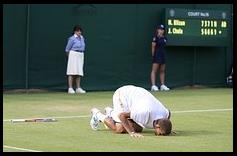 Both tall guys won five-setters with at least ‘7’ on their side in each winning set, not every player gets such a win during a long career. Troicki fought off a break point with an ace at 3-all in the decider against Marcel Granollers, Klizan blew two match points against Juan Ignacio Chela [83] at 5:4*, was broken in the 13th game, seemed downhearted, but Chela couldn’t capitalize the opportunity despite had won his seven previous five-setters. Now he has lost seven straight matches… Klizan finished the longest match of the first round (and the longest match in Chela’s career, who announced retirement afterwards) with a backhand winner to kiss the grass.
The rain fell on Tuesday and halted three matches in the presumably final games. It could turn into a nightmare Jurgen Melzer‘s match against Stanislas Wawrinka. The Austrian couldn’t convert three match points on serve on a slippery court producing awful unforced errors every time, and the match was resumed at 5:4 ‘deuce’ on Wednesday with Melzer losing first six points quickly. After a change of ends Melzer regrouped, broke the Swiss and with a bunch of service winners concluded the bizarre contest. Wawrinka also in Paris three weeks ago lost a two-day 5-setter resumed in the final set. Melzer luckily escaped, in contrary to Edouard Roger-Vasselin, who wasted a triple match point on serve in the deciding set against Guillermo Garcia-Lopez – the Spaniard last year won his matches in dramatic fifth sets as well, 13-11 in Paris and 7-6 in New York, against Roger-Vasselin prevailed 6-7 6-3 7-5 5-7 10-8 in 4 hours 48 minutes.
Longest match: 4 hours, 53 minutes. Martin Klizan d. Juan Ignacio Chela 7-5, 3-6, 7-6, 1-6, 11-9
Most aces: 48 – Nicolas Almagro, defeated Olivier Rochus in five sets
5-set barometer:
20-18 Tommy Haas, 18-13 Stanislas Wawrinka, 15-13 Jurgen Melzer, 12-5 Philipp Kohlschreiber, 11-21 Olivier Rochus, 10-11 Andreas Seppi, 10-8 Nicolas Almagro, 8-8 Viktor Troicki, 7-9 Juan Ignacio Chela, 6-2 Marcel Granollers & Denis Istomin, 5-3 Guillermo Garcia-Lopez, 4-8 John Isner, 4-5 Alejandro Falla, 3-4 Nicolas Mahut & Florent Serra, 2-4 Flavio Cipolla, 2-3 Malek Jaziri & Edouard Roger-Vasselin, 2-2 Wayne Odesnik, 2-0 James Ward, 1-4 Pablo Andujar, 1-3 Steve Darcis & Bjorn Phau, 1-2 Martin Klizan & Jurgen Zopp, 1-0 Guillaume Rufin & Inigo Cervantes, 0-2 Andrey Kuznetsov, 0-1 Paolo Lorenzi
Posted in Tournaments
4 Comments
Wimbledon 1980
Wimbledon ’80 is one of the most memorable tennis events of all time due to the legendary final in which the four-time defending champion Bjorn Borg [1] met his toughest challenger – John McEnroe. The best players of the world at the time, created magnificent show, featured by the longest tie-break in major finals, and one of the longest ever. The ice-cold Borg choked a bit in the 4th set in unusual style, but regained the composure in the decider and celebrated the triumph more emotionally than any other title in his amazing career. Read more…
Posted in History
Leave a comment
25th week
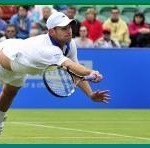
This gallery contains 1 photo.
“I wanted to keep alive winning one tournament a year for 12 years. I know three or four people have done that,’ Andy Roddick [32] said about equaling Federer’s record of winning at least one title in 12 consecutive seasons. The … Continue reading
US Open 1997
Pete Sampras was a huge favorite to become the first man since 1988 to win three Grand Slam tournaments within a year. However, he was ousted in the last 16 by an inspired Petr Korda, in the same round other American champion Andre Agassi (out of form in 1997 but very solid in the first week of the UO ’97 edition) was eliminated as well. It opened the draw for young attacking players, Jonas Bjorkman [17], Greg Rusedski [20] and Patrick Rafter [14], the latter dealt the best with the underdog status becoming a sensational new champion. The US Open ’97 featured the beginning of decline for Michael Chang, who in that event wasted his last opportunity to prove that his Roland Garros ’89 triumph wasn’t a fluke. Read more…
Posted in History
Leave a comment
24th week
This gallery contains 1 photo.
The first week of the short grass-court season brought many upsets. As early as in the opening match at Queens Club, the defending champion Andy Murray was ousted by a grass-court specialist Nicolas Mahut, 6-7 in the deciding set. Murray, … Continue reading
Roland Garros – final
This was a unique moment in tennis history and a tremendous stake for both final participants. For the first time two players created a “common Grand Slam” – it’s not only the first time that two players met in all Grand Slam finals but it was the fourth consecutive major final (!) between Djokovic and Nadal #, the two giants of modern tennis. They were both facing not only each other in the final, but the tennis records as well, Djokovic was bidding to become the first man since Rod Laver (1969) to win four consecutive Grand Slam events while Nadal was trying to equal Pete Sampras‘ record of the most triumphs at one major (7). It was like a pattern out of this world because Djokovic had faced two match points at the last year’s US Open and four match points a couple days ago in Paris…
(2)Rafael Nadal d. (1)Novak Djokovic 6-4, 6-3, 2-6, 7-5 [3:49 h]
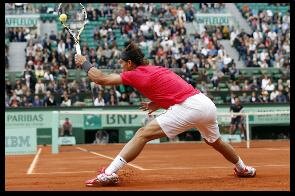 The occasion was exceptional and the match memorable due to very bad weather which extended it over two days. Djokovic began this final unluckily, losing the first three points on serve, he saved a triple break point, but on the fourth b.p. made a backhand error. Nadal held a *3:0 lead, but Djokovic – just like a few days before (against Federer) – erased a double break hole, and was two points away from leading 4:3 – committed a double fault though, trying to save a break point – it was 1 out of barely his four double faults in the final, but 2/4 occurred in extremely vital moments… It’s clear that two best return players in the world met on the court, so service games were not particularly crucial on a heavy and very slow surface, the most important were punishing baseline rallies, and Nadal was a dominant figure in the vast majority of them. Difficult conditions on Philippe Chatrier stadium worsened and the rain interrupted the final at 5:3 for Nadal in the 2nd set. After a 34-minute rain delay, Nadal broke Djokovic with a stunning backhand pass (sliding himself) to take a two-set lead. It seemed that the match was over when he held his own service game and broke easily the Serbian player once again at the start of the 3rd set. Then, Djokovic realized he had nothing to lose and started to deliver his best tennis, Nadal was running from side to side but couldn’t do anything
 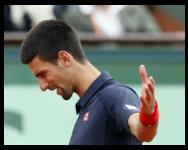 against well-placed balls that Djokovic was producing from all angles of the court with astonishing accuracy. So, after six straight games for Nadal (Djokovic led 3:2* in the 2nd set), the Serb notched an 8-game winning streak – Nadal’s first lost set after 30 winning in a row!! The Spaniard finally got his service game and this time the rain helped him to halt the overwhelming disposition of Djokovic. [ The last time the men’s final was not completed on Sunday was in 1973. Bad weather meant the match could not be completed until the Tuesday, when Ilie Nastase beat Niki Pilic 6-3 6-3 6-0. ] The final was resumed on Monday at 1 p.m. and Nadal broke back immediately to ’30’. Since then, they were holding service games quite comfortably until the 12th game – Djokovic led 30/15. One point later Nadal won a 10-stroke rally with a forehand winner to get the first match point. And then, happened a small tragedy for Djokovic – he bounced 26 times before the serve (16 & 10 intervals) but missed, 8 times before the second serve and failed again despite he didn’t even risk that second serve. His head dropped in disillusionment with sight towards the clay, meantime, on the other side of the net Nadal celebrated on his knees another Parisian crown, covering his head with both hands. Then, he jumped like a Tarzan onto the stadium to hug his friends and family. “For me it is a real honour. Borg is one of the greatest in history, one of the more charismatic players in history,” Nadal said in a post-match interview with John McEnroe. “The comparison with the great Bjorn is fantastic. He’s always been very nice to me, so I have to say thanks.”
 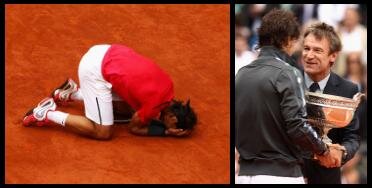 Nadal has overcome Bjorn Borg‘s record of six triumphs in Paris, now he is tied with Pete Sampras in the most titles in a Grand Slam tournament. With his 11th major crown, Nadal moves into a third-place tying with Borg for the most singles championships in the Open era ##. He also becomes just the 10th player of the Open era history to win 50 titles on the ATP World Tour, with 36 of his successes occurring on clay. La Coupe des Mousquetaires Nadal received from the three-time champion Mats Wilander. ### The runner-up, and still the best player in the world, who has lost first major encounter after 27-match winning streak, said: “I could easily have lost the match in fourth round or even more against Tsonga, but I managed to come to the final for the first time in my career. I should be happy about that. I thought we played a fantastic match where people hopefully enjoyed yesterday and today, and I was even surprised with the number of people who attended this match today. It was a working day, but it was still a full stadium. It’s beautiful. These matches make you feel like all the work that you put into it is worth [it].” Stats of the final.
Doubles final:
(1)M.Mirnyi/D.Nestor d. (2)B.Bryan/M.Bryan 6-4, 6-4
# Four consecutive major finals between Djokovic and Nadal:
(for the first time in the Open era two players met in four consecutive Grand Slams!)
Wimbledon 2011: Djokovic d. Nadal 6-4, 6-1, 1-6, 6-3
US Open 2011: Djokovic d. Nadal 6-2, 6-4, 6-7(3), 6-1
Australian Open 2012: Djokovic d. Nadal 5-7, 6-4, 6-2, 6-7(5), 7-5
Roland Garros 2012: Nadal d. Djokovic 6-4, 6-3, 2-6, 7-5
## Most major titles in the Open era:
16 – Roger Federer (2003-10)
14 – Pete Sampras (1990-02)
11 – Bjorn Borg (1974-1981) & Rafael Nadal (2005-12)
### Longest Grand Slam match winning streaks in the Open era:
29 – Rod Laver (1969-70)
27 – Roger Federer – twice: (2005-06) & (2006-07); Novak Dokovic (2011-12)
25 – Jimmy Connors (1974-75); Pete Sampras (1993-94) & Rafael Nadal (2010-11)
Roland Garros – semifinals
2nd semifinal:
(1)Novak Djokovic d. (3)Roger Federer 6-4, 7-5, 6-3 [2:05 h]
In a repeat of last year’s dramatic semifinal, Djokovic avenged that 4-set defeat easier than could have been expected. Federer led with a break in the 1st set (3:2), with a two-break advantage in the 2nd set 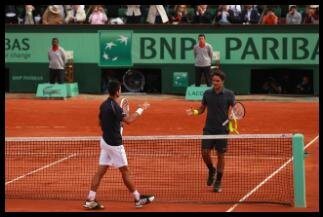 (3:0), he broke the Serbian fighter also at 4-all to serve for the set, lost the vital game to ’30’ though, and since that moment the match was actually over. Djokovic added another break (the fourth in the set!) to increase his lead to two sets to none. Federer admittedly played just one set more than Djokovic en route to the semifinal but he is almost six years older and much more spent, moreover he was 0-2 down in his previous match. All these factors made an impact on the third, rather boring set in which Djokovic hadn’t any problems to win all service games and broke once the forehand-error spreading Swiss maestro. ”I hope we’ll play a shorter match because playing six hours in Australia was very long,” Djokovic said on final. ”But it was a great match. I think it was the most beautiful match of my life, of my career. I look forward to another beautiful match.” Federer stated: ”‘I was actually feeling particularly well in the second set, and that one hurts the most to lose. In the third, I don’t know, I just wasn’t able to put a good game together anymore. You’re down two sets to nothing against Novak and it’s not the same match anymore. He goes for broke and has no fear and that’s about it.” It was their record-tying tenth meeting in Grand Slam tournaments. Federer should overcome this record this year with either Nadal or Djokovic. Stats of the match.
# Most matches at majors:
10 – Rafael Nadal vs. Roger Federer (8-2)
10 – Ivan Lendl vs. John McEnroe (7-3)
10 – Roger Federer vs. Novak Djokovic (5-5)
1st semifinal:
(2)Rafael Nadal d. (6)David Ferrer 6-2, 6-2, 6-1 [1:46 h]
The best Spanish players of the last few years, create one of the biggest “head to heads” in the modern history of tennis, unfortunately a lopsided one. Before this semifinal they had played 19 times with Rafa winning 15 matches, so obviously he was a huge favorite but the way he outplayed Ferrer this time, could surprise a bit the rather empty stadium (people began gathering in the 3rd set awaiting another semifinal). Quite modest expectations of an equal encounter evaporated in the 4th game of the 1st set. Ferrer wasted two break 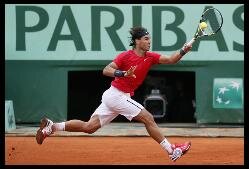 points and it was a one-way traffic since then. Nadal showed a flawless tennis while the underdog made more unforced errors than usual. The six-time champion even when slipped and fell on his bottom, was able to play a good dropshot from uncomfortable position and a volley-lob in the following stroke already standing! Even a short rain-break at 4:1 for Nadal in the 2nd set didn’t help the older Spaniard. Serving to win that set, “King of clay” displayed his majesty: played a beautiful backhand overhead (15-all), and made a passing-shot with a blistering forehand on a full speed (40/15). He is yet to lose a set in six matches losing only 35 games in total (he advanced to French Open finals in similar style also in years 2007, 08 & 10). For Ferrer it’s the third semifinal defeat in majors (US Open 2007, Australian Open 2011). “I tried to do my best, but when the opponent was better than me in the moment, there’s nothing I can say,” commented the loser. “He played all the time very good; I didn’t have any chance. Rafael is a very good player on clay courts. He’s the best in history, and today he did an amazing match. I’m very happy with my game all tournament. Maybe today was not the best match of these two weeks, but it’s my first semi- final in Roland Garros.”
Roland Garros – quarterfinals
4th quarterfinal:
(6)David Ferrer d. (4)Andy Murray 6-4, 6-7(3), 6-3, 6-2 [3:45 h]
It was a grueling battle (on Suzanne Lenglen) between two players with very similar clay-court skills. Ferrer after winning four consecutive matches without any problems, confirmed his great form jumping to a 5:2* (adv.) lead. Murray saved the set point and afterwards had two game points to level the score. In 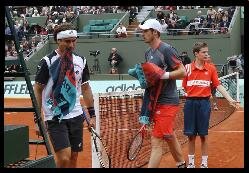 the 2nd set (almost entirely played in a drizzle) Ferrer came back twice from a break down but Murray prevailed in the tie-break thanks to very offensive attitude. The rain was heavier and officials decided to suspend the last quarterfinal as Murray led 1:0* in the 3rd set. It was a very good circumstance for the Spaniard because Murray is known for an ability to shift the momentum onto his side while winning a “contact set”, he had already shown it twice this year in Paris (against Nieminen & Gasquet) and many times in the past, also against Ferrer during their last year’s semifinal in Melbourne. The rain-break lasted between 6:45 p.m. and 7:12 p.m. local time. When players returned, Ferrer won the longest game of the match to take a 2:1 lead (five deuces, Murray squandered five game points). It was the turning point, Murray leveled in that set at 3-all but Ferrer’s ascendancy was visible more and more. The Scot began to signal back problems in the 4th set and made an unforced backhand error trying to save the second match point. He has been ousted before semifinals in Grand Slams for the first time since Australian Open 2011; Ferrer advances to his first Parisian semifinal in ten attempts (previously reached that stage in New York and Melbourne). “I thought I played some good tennis tonight,” said Murray. “I just didn’t convert. I mean, I had a lot of chances in the last couple of sets on his serve and I lost a lot of really long games on my serve, which didn’t help.”
3rd quarterfinal:
(2)Rafael Nadal d. (12)Nicolas Almagro 7-6(4), 6-2, 6-3 [2:46 h]
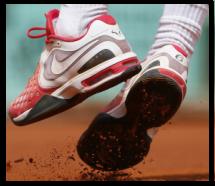 Almagro entered this quarterfinal having won the last eight matches in straight sets, including victories over very good players (Simon, Baghdatis, Tipsarevic); he has strong serve and blistering forehand on the rise – all these things could indicate some problems for Rafa… if he had not won all seven meetings with Almagro… The older Spaniard showed his A-tennis in the first six service games, but since losing the opening point on serve in the tie-break his chances dropped drastically. Nadal is almost unbeatable in Paris, the only loss he has suffered occurred when he was outplayed in the 1st set (to Soderling three years ago). Everyone knows it, knows it Almagro as well. There’s nothing more to say about Almagro in sets Nos. 2 & 3 that he was on the court and won a few good points. Nadal records his 50th win in Paris, and his new shoes (with No. 6) won’t be probably up-to-date next Sunday when he will have won his 7th Roland Garros title overcoming Bjorn Borg, who celebrates today his 56th birthday. For Almagro it was third major quarterfinal, third in Paris against Nadal, each one in two-year intervals, below all these matches (played on Philippe Chartier):
2008: Nadal d. Almagro 6-1 6-1 6-1
2010: Nadal d. Almagro 7-6(2) 7-6(3) 6-4
2012: Nadal d. Almagro 7-6(4) 6-2 6-3
2nd quarterfinal:
(1)Novak Djokovic d. (5)Jo-Wilfried Tsonga 6-1, 5-7, 5-7, 7-6(6), 6-1 [4:09 h]
If Tsonga had won this match, it would have been one of the most remembering days in the modern French history of men’s tennis. If… Tsonga was atrocious through a set and a half. The serve didn’t work, the forehand was an error-machine. It allowed Djokovic to possess a pleasant, yet tricky 6-1 4:2 lead. Quite often comfortable leading 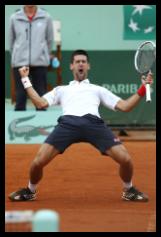 against a dangerous opponent is delusive though – it was one of those cases, once Tsonga broke back, he was a different type of player. Especially that he knows how to deal with tight situations, and Djokovic almost lost three straight tight sets for the first time in his career… There was a drizzle in the 4th set, Tsonga held a double match point on return at 5:4 – it was the closest point out of four m.p. chances he squandered on that day: Djokovic played an overhead after a bounce, followed by a backhand volley, and Tsonga was in position he passes often well, but delivered too casual backhand and the No. 1 finished the point with a forehand volley. The second match point was saved with a cross-court forehand on the third stroke. Two games later Tsonga had two match points again, this time on advantages: first he made a forehand error, the fourth m.p. Djokovic fought off with a smash. In the tie-break Tsonga led 4:2* when a long rally occurred with a couple of slices from both sides, the Frenchman failed, and it was a turning point. This rally and that one which he won at 2-all (17 strokes – the longest rally of the match) cost him too much energy. Admittedly he saved a double set point, but at 6-all made a simple forehand error followed by a backhand error and enthusiastic Parisian crowd fell silent. The vast majority of supporters left the stadium, it’s tough to say unequivocally whether they felt correctly the final outcome or their lack of support made an impact on Tsonga’s powerless display in the decider. “As a tennis player, this is what you live for,” said Djokovic. “This is what you practise for all these years, to be part of an incredible performance, incredible match encounter here in Roland Garros with the home players. I’m really glad that I could win today.” Tsonga stated: “This is probably the most difficult defeat or loss in my career. It’s very rare for me to have match points and not win the match, so I [will] remember that because it was Roland Garros; it was a quarter-final.” Such a defeat occurred to him for the fourth time in 102 main level tournaments (Simon in Rome ’08; Clement in Lyon ’09, Nalbandian at Indian Wells ’12 & Djokovic in Paris).
1st quarterfinal:
(3)Roger Federer d. (9)Juan Martin del Potro 3-6, 6-7(4), 6-2, 6-0, 6-3 [3:14 h]
It’s an unfortunate concept in my opinion that quarterfinals in Paris are played simultaneously on two biggest arenas. On Tuesday, when Federer won his second match point against Del Potro, Tsonga held one of his match points against Djokovic on Philippe Chartier, fans on a stadium are excluded of following important events on a different court, fans in houses have to deal with switching between streams or TV channels… Anyway it was a high quality match through first two sets, especially in the 2nd set as Juan Martin broke back 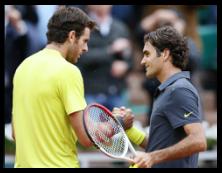 immediately in the middle of the set and saved three break points at 4-all. The Argentinan kept the strong ball consequently on Federer’s backhand not permitting the Swiss to mix the pace. Del Potro had never lost a two-sets-to-love lead prior to Roland Garros ’12, but… this tournament cost him physically too much. He was needlessly involved in 4-setters against inferior opponents (Montanes, Roger-Vasselin), losing sets in these matches despite being close to wrap them up. He also played about 30 minutes longer set against Cilic (than had been required, cause DelPo wasted six set points before took the set in a tie-break… saving a double set point). His bandaged left knee finally manifested itself with an increasing pain, and the US Open champion ’09 melted in the last three sets. Only in the 1st game of the final set appeared a ray of hope as he had two break points. “[The] second set was a tough set for me to lose, but he played a really good breaker and got the better of me. But I was happy that the first two sets took some time, because I did favour myself once the match got longer. I’m very happy with the way I fought and started in the third set, fourth set, and even in the fifth set, where, obviously, it was the toughest, because that was his last chance and his resistance maybe was the strongest there.” commented Federer, who since 2nd set of this match played much more convincing tennis than in his previous encounters against players of “lower leagues”. Federer has already beaten Del Potro on five occasions this year (four times in straight sets)!
5-set barometer:
19-16 Roger Federer, 17-5 Novak Djokovic, 8-4 Jo-Wilfried Tsonga, 4-5 Juan Martin del Potro
Roland Garros 1993
It was an end of some period – the time of emphatic Jim Courier‘s dominance. The American at the time was an undisputed king of clay, who had won the last four biggest tournaments on this surface (Roland Garros 1991-92 & Rome 1992-93), En route to the French Open final ’93, he didn’t impress but not too many pundits could expect his dethronization from hands of Sergi Bruguera, whom Courier had beaten on four previous occasions not dropping a set even once. Read more…
Posted in History
Leave a comment