
My eBook

Categories
-
Recent Posts
September 2026 M T W T F S S 1 2 3 4 5 6 7 8 9 10 11 12 13 14 15 16 17 18 19 20 21 22 23 24 25 26 27 28 29 30
Roland Garros – round 3rd + 4th
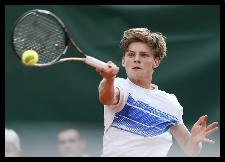
The 21-year-old David Goffin [109] of Belgium came to Paris with a humble 5-5 main-level record of 2012, yet became a tournament revelation. The young player was defeated in his last qualifying match by Joao Souza 3-6 6-7, but jumped into the main draw thanks to withdrawal of Gael Monfils. In the opening two rounds he won first
Longest match: 4 hours, 33 minutes. Juan Monaco d. Milos Raonic 6-7, 6-3, 6-7, 6-3, 6-4
Australian Open: Glenn Layendecker (3rd round 1991)
RG, 2R: Mathieu d. Isner 18-16 in 5th set!
I guess this match deserves a special entry because one record has been broken – the longest 5th set in terms of games in the Roland Garros history. Paul-Henri Mathieu [261], who didn’t play a pro-match in 2011, came back on Philippe Chartier court after three years (in 2009 he was beaten in the third round by Roger Federer), John Isner in his debut on this court took unexpectedly Rafael Nadal to a 5-setter last year. There wasn’t anything unusual on Thursday evening until the 5th 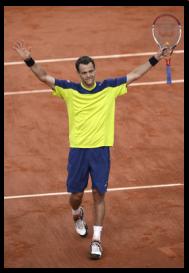 set: one tie-break (two breaks of serve before), three sets decided by one break. Through a long sequence of the deciding set they both were serving perfectly and winning games on serve wasn’t any problem at all. When they reached 5-all after ten quick service holds, I thought that Isner would prevail considering his extraordinary experience obtained against Nicolas Mahut at Wimbledon two years ago and Mathieu’s poor record in decisive tight sets. The Frenchman was displaying very positive attitude though, fist pumping many times, always after holding another service games. He was closer to make the final blow – 6:5 (30/15), 11:10 (40/0), 15:14 (40/15) whereas Isner had his chance only in one return game which occurred at 7-all, Mathieu saved two mini-match points, one with a service winner, the other one with a high forehand volley (Isner slipped trying to pass). Around 10-all Isner signalized fatigue, his 1st serve dropped around 30 km/h, but the high kick-serve and hard forehand kept him in the match…. until 34th game – on 7th match point he sent a forehand wide from relatively good position. Mathieu celebrated rather calmly, he was more emotional after shake-hands when saw the standing ovation. He had lost a few dramatic matches in Paris, so this victory is some form of consolation for him. “I remember Mahut’s match, so I just couldn’t believe it was over,” admitted Mathieu. “I had match point. It was tough. Every time I needed to concentrate and focus again on my serve, so when the match was over, I had trouble realizing it was really over. Before I
 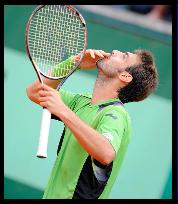 used to become very tense at the end of a match like this. But in the fifth set I was always ahead. I was up in the scores and I was serving first so that it was an advantage.” Isner commented: “I escaped a lot today; it could have been worse. But I just didn’t get it done. I felt like I got caught in patterns that weren’t ideal for me. I was hitting every return to his backhand and he was stepping up and running me around. I’m not gonna win the point when I’m running side to side.” The American saved 20 of 24 break points faced on serve, all in vain in the end.
Mathieu’s next opponent was revealed in dramatic fashion as well: 28-year-old Malek Jaziri had a huge opportunity in the last second round match to beat Marcel Granollers (suspended on Thursday at two sets apiece due to darkness) producing the biggest success of Tunisian tennis in history. Malek had played one Grand Slam tournament before – US Open 2011 where he lost as a qualifier to Mardy Fish in the second round. Against Granollers, served at 5:4 (40/15) in the 5th set, but squandered those match points, another one, and lost three games in a row. The match lasted 4 hours 27 minutes (78 minutes on Friday). The Spanish player returned on court some time later and spent on it additional two hours losing a doubles match along with Albert Montanes 6-4 6-7(5) 3-6 to Eric Butorac & Bruno Soares (the Spaniards led 5:3 in the tie-break).
Granollers and Mathieu met on Saturday on court No. 1, and the Spaniard survived the second straight 5-setter (6-4 6-4 1-6 4-6 6-1) in 3 hours 56 minutes (the latest concluded third round match) overcoming a beat-down in the second phase of the match (Mathieu had a break point for a 5:0 lead in the 4th set). Granollers has advanced to the fourth round of a Grand Slam tournament for the first time in 19 attempts. He has won his last six 5-setters.
ROLAND GARROS records:
Longest 5th sets in terms of games:
2012: 2R – Paul-Henri Mathieu d. John Isner 6-7, 6-4, 6-4, 3-6, 18-16 *
2007: 1R – Philipp Kohlschreiber d. Lukas Dlouhy 6-2, 3-6, 7-5, 4-6, 17-15
2004: 1R – Fabrice Santoro d. Arnaud Clement 6-4, 6-3, 6-7, 3-6, 16-14
1985: 1R – Darren Cahill d. Mark Dickson 3-6, 6-2, 6-1, 2-6, 14-12
1994: 2R – Ronald Agenor d. David Prinosil 6-7, 6-7, 6-3, 6-4, 14-12
Longest matches: **
6 hours, 35 min. Fabrice Santoro d. Arnaud Clement 6-4, 6-3, 6-7(5), 3-6, 16-14… 2004, 1R
5 hours, 41 min. Paul-Henri Mathieu d. John Isner 6-7(2), 6-4, 6-4, 3-6, 18-16… 2012, 2R
5 hours, 30 min. Alex Corretja d. Hernan Gumy 6-1, 5-7, 6-7(4), 7-5, 9-7… 1998, 3R
5 hours, 4 min. Guillermo Canas d. Paul-Henri Mathieu 6-3, 7-6(4), 2-6, 6-7(5), 8-6… 2005, 3R
5 hours, 0 min. Ronald Agenor d. David Prinosil 6-7(4), 6-7(2), 6-4, 6-3, 14-12… 1994, 2R
Most aces:
55 – Ivo Karlovic (2009) 5 sets, lost to Lleyton Hewitt
41 – John Isner (2012) 5 sets, lost to Paul-Henri Mathieu
39 – Ivo Karlovic (2008) 5 sets, lost to Alejandro Falla
38 – John Isner (2010) 4 sets, defeated Marco Chiudinelli
37 – Andy Roddick (2001) 5 sets, defeated Michael Chang
* It’s the fifth longest 5th set (in terms of games) and 4th longest match in Grand Sam history
** Mathieu and Isner played the longest match in Paris within a day; all other four matches lasted two days, suspended due to darkness
Roland Garros – round 1st + 2nd
The tournament kicked off without three Top 20 players: Mardy Fish, Gael Monfils and Kei Nishikori, but it’s tough to expect they could play important roles during the fortnight, especially the American, who has been out of form since last Autumn. Fish was diagnosed with fatigue, he had a procedure called “cardiac catheter ablation” on Wednesday to deal with misfiring electrical pulses in his heart. “It felt like my heart was going to jump out of my chest,” he said. He has a lot of points to defend in the next few months so very likely will drop after the US Open outside the Top 20. Admittedly Monfils reached quarterfinal in 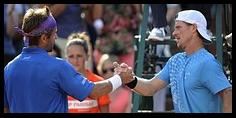 Paris last year, but in his three clay-court tournaments this year obtained a mediocre 3-3 record.
In the first two days French 30-year-old-plus veterans delivered positive emotions for their Parisian supporters: “the marathon man” Nicolas Mahut [89] ousted in four sets Andy Roddick [30], who probably played next to last time in majors as a seeded player. The American in his last five matches managed to win just one set… against Mahut; Mickael Llodra snapped a 5-match losing streak ousting also in 4 sets, Guillermo Garcia-Lopez; Paul-Henri Mathieu was badly beating by Bjorn Phau but since 0-2 & 4-all (30-all) in the 3rd set, he completely dominated his German opponent winning 14 out of 17 games; finally Arnaud Clement [139], who had announced 2012 would be his last season in career, prevailed a 5-setter against Alex Bogomolov [46] in uncommon circumstances. The short Frenchman saved a match point with a serve-and-volley in the 4th set and torturing “new Russian” in the decider with drop-shots forced him to exceptional effort. After one of them Bogomolov suffered cramps, in the following points he was supposed to face first match point, but decided to avoid serving and retired at unusual scoreline being match point down (!), however, he had done the same thing last season at Queens Club (against Igor Kunitsyn) # Clement just after this 4-hour-17-minute battle was kissed in his right hand by Jean Gachassin – the president of Fédération Française de Tennis 🙂
The comeback man – Brian Baker [141] – proved that magical run in Nice wasn’t accidental. Just two days after losing the final at Côte d’Azur, the American playing in Paris thanks to “wild card” (clinched it triumphing at Savannah challenger in April as a qualifier) in his first major match since 2005, met a guy who had beaten him in the previous Grand Slam match at the US Open seven years ago – Xavier Malisse. 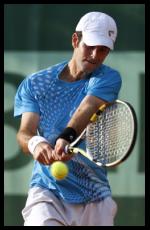 This time Baker avenged that defeat eliminating the Belgian in three sets. “I kinda had a little bit of confidence, too, going out there,” Baker said after first Grand Slam match in seven years. “I wasn’t as nervous as maybe I was in the U.S. Opens in the past. Last week [in Nice] helped me a ton, just beating some of those good players. You’re gonna have more nerves in a Grand Slam match. It’s just part of the game.” Baker’s quick and acute backhand motion wasn’t formidable enough to jump over another obstacle – Gilles Simon, but the American experienced his first 5-setter, and it happened on one of the most famous tennis courts – Philippe Chartier. Baker was two points away from losing the match in straight sets when he played one of the best forehands that day, eventually lost 4-6 1-6 7-6 6-1 0-6 under three hours. It was second round match, in the first round, Simon’s compatriot Jeremy Chardy [55] experienced the same scoreline progress through three sets, but had to wait until the latter stages of the 5th set against Yen-Hsun Lu to finally make a celebration. Chardy led two-sets-to-love and 5:2* (30/15), he had a match point on serve in the following game, a triple match point at 9:8* in the 5th set to ultimately win 6-4 6-1 6-7 3-6 11-9 in 4 hours 10 minutes on Court No. 3. Third match of this type occurred on Court No. 14 – Ernests Gulbis, who defeated Andy Murray a couple days ago in two tie-breeaks in an exhibition meeting, still struggles with finding a form which moved him to French Open quarterfinals in 2008. In the first round against Mikhail Kukushkin, the flamboyant Latvian [93] had a decent prospect to get one of the most amazing comebacks in the Grand Slam history: he won the 3rd set despite facing a triple match point at 1:5* (0/40) and had a break point for a double break in the decider – Kukushkin [53] prevailed 6-4 7-6 5-7 2-6 6-4, he had beaten in similar circumstances Monfils during the last Australian Open.
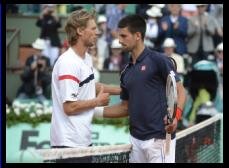
Three best players in the world compete not only with each other in this tournament, but with the tennis history as well… Novak Djokovic is bidding to become the first player since 1969 to win four consecutive Grand Slams. Facing similar task, previously in Paris stumbled Pete Sampras (1994 – quarterfinal) & Roger Federer (2006, 2007 – finals), Rafael Nadal could win four majors in a row last year in Melbourne but was outplayed at the Australian Open quarterfinal by David Ferrer. Djokovic signed a new contract for his clothes just before the tournament, replacing Sergio Tacchini by a Japanese brand – Uniqlo. The Serb didn’t delight his supporters in opening matches with a new logo on his chest – admittedly he didn’t lose a set but had surprising problems in one set in each of his first two matches, against Potito Starace and Blaz Kavcic (the Slovenian ousted Lleyton Hewitt in R1 – first tournament for him since Australian Open) “I didn’t expect an easy match, that’s for 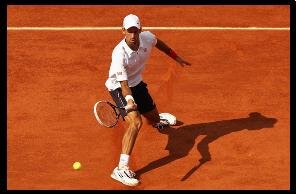 sure. He is a specialist on clay,” said Djokovic on Starace “I have seen him in the past couple of years. He gave a lot of trouble to the top players on this surface. I tried to be aggressive on the court and take my chances. When I look at it now, after the match is over, maybe it was good for me to have the tough first set and try to find the good control and rhythm and movement on the court.” His statement about * Baker: “You know, he always had a very smart game, a variety of shots. I haven’t seen him play, though, this year, but, you know, it’s great to see him back.” Nadal still sticks to Nike but in a new color – orange has been replaced by the red, the Spaniard may tie Sampras’ record of number of triumphs in one major – seven. Federer has already broken a record of the most Grand Slam wins ##. The Swiss unexpectedly had to wait for it one set longer than everyone would have expected, because all of a sudden he lost a tie-break to Adrian Ungur (GS novice) from a double match point. The fourth biggest gun in men’s tennis – Murray suffered a back pain while serving at 0:3 in the 1st set against Jarkko Nieminen. The Brit needed a 3-minute medical time-out and 6-7 games to return to his normal physical shape. The Finn led 4:2* (deuce) in the 2nd set when totally fell apart and lost 6-1 4-6 1-6 2-6 the match which at some rallies looked like a promise of a 3-set upset. For these best players winning opening two rounds in a major is a walk in the park, for others sometimes it’s a career-best achievement, for example for a 32-year-old Nicolas Devilder [286] who threw his racquet into stands after winning match point against Michael Berrer. Devilder until 2007 never even played in Grand Slam qualifying rounds, this week as a qualifier he has reached last 32 of a major for the first time in life. The joy was tremendous, it’s tough to expect that probable bitter Devilder’s loss of Djokovic’s
 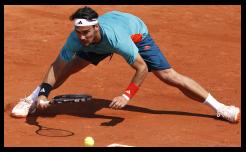 hands would overshadow triumph achieved over Berrer. Devilder’s compatriot Mahut also has been unexpected in the third round. In his second match, Mahut dismissed in four sets Martin Klizan of Slovakia, taking a game at 5:5 in the 3rd set after 12 deuces on serve (4-6 6-4 7-6 6-3). Mahut fired 20 aces in that match on Court No. 2. Fabio Fognini [45] becomes the Roland Garros legend. Every year he wins dramatic fifth sets on different courts ###. Two years ago he saved a mini-match point against Monfils (it could be the latest finished match in Paris but suspended), last year despite cramps survived five match points against Albert Montanes, this year withstood two match points against a specialist of losing match point-up encounters – Viktor Troicki. The Serb blew first m.p. leading 6:5* (40/30) when he tried to finish the point with a backhand DTL – netted, on second m.p. Fognini approached the net, played a decent volley and Troicki netted again, this time with a shaky forehand.
Longest match: 4 hours, 50 minutes. Kevin Anderson d. Rui Machado 7-6, 6-7, 4-6, 6-1, 11-9
Most aces: 26 – Kevin Anderson, defeated Rui Machado (first round)… [excluding the Isner-Mathieu thriller]
5-set barometer:
17-11 Stanislas Wawrinka, 14-13 Jurgen Melzer, 13-21 Radek Stepanek, 13-20 Arnaud Clement, 9-9 Andreas Seppi, 8-9 Victor Hanescu & Paul-Henri Mathieu, 8-5 Yen-Hsun Lu & Gilles Simon, 7-8 Viktor Troicki, 7-2 Gilles Muller, 6-5 Fabio Fognini, 6-3 Alexandr Dolgopolov, 5-2 Mikhail Kukushkin, 5-1 Marcel Granollers, 4-7 Thomaz Bellucci & John Isner, 4-4 Kevin Anderson, 2-6 Alex Bogomolov, 2-4 Ernests Gulbis & Rui Machado, 2-3 Flavio Cipolla, 2-0 David Goffin, 1-3 Michael Berrer, Malek Jaziri & Pablo Andujar, 0-3 Bjorn Phau, 0-1 Igor Sijsling & Brian Baker
# Alex Bogomolov’s retirements facing match point:
Queens Club 2011: Igor Kunitsyn 4-6, 6-6(3:6)
Roland Garros 2012: Arnaud Clement 2-6, 6-3, 6-4, 6-7(4), 4-5 (adv. Clement)
## The most wins in Grand Slam tournaments:
234 – Roger Federer (1999-2012)
233 – Jimmy Connors (1970-1992)
224 – Andre Agassi (1986-2006)
222 – Ivan Lendl (1978-1994)
203 – Pete Sampras (1988-2002)
### Fabio Fognini’s dramatic wins at Roland Garros:
2010 – R2, Philippe Chartier: Gael Monfils 2-6, 4-6, 7-5, 6-4, 9-7 (4:16 h)
2011 – R4, Suzanne Lenglen: Albert Montanes 4-6, 6-4, 3-6, 6-3, 11-9 – 5 m.p. (4:21 h)
2012 – R2, Court No. 6: Viktor Troicki 6-2, 3-6, 4-6, 6-3, 8-6 – 2 m.p. (3:30 h)
* Djokovic lost to Baker (2-6 4-6) the only time they met – qualifications to Adelaide ’05. Baker as a junior beat the current best players of his age: Tsonga, Baghdatis, Isner (6-1 6-0!), Wawrinka & Stakhovsky.
Roland Garros 1990
It was wide open tournament, the long-time No. 1 in the world – Ivan Lendl was gradually declining, and withdrew from the competition in Paris for the first time since his debut in 1978, Chang’s second miracle in a row was very doubtful, two-top seeded players (Stefan Edberg, Boris Becker) weren’t favorites on their least favorite surface; because of that Andre Agassi had to deal with tremendous pressure… 30-year-old Andre Gomez [7], one of the best players of the previous decade, took an advantage of the favorable circumstances and got his first and only major title. Read more…
Posted in History
Leave a comment
21st week

This gallery contains 1 photo.
Serbia weakened by the lack of Novak Djokovic, for the second time in the last three years claimed World Team Cup. It was a perfect tournament for both singles players: Janko Tipsarevic and Viktor Troicki, who won all their 4 … Continue reading
US Open 1984
1984… it was a year of John McEnroe‘s total dominance. The American prior to the US Open ’84 had lost just two matches of the season (!), and confirmed his supremacy over the tennis elite outplaying Ivan Lendl in the final, revenging a French Open defeat. The tournament was highlighted by dramatic semi-finals on super Saturday, arguably the most exciting semi-final day in majors of the Open era. Read more…
Posted in History
Leave a comment