
My eBook
Categories
-
Recent Posts
November 2026 M T W T F S S 1 2 3 4 5 6 7 8 9 10 11 12 13 14 15 16 17 18 19 20 21 22 23 24 25 26 27 28 29 30
30th week
This gallery contains 1 photo.
A holder of a weak 1-6 record lately, Robin Haase [42] is well adjusted to the hight altitude – in Kitzbuhel (800 m), as a defending champion, he won his second career title. Just like a year before, he got … Continue reading
Clement’s farewell
This gallery contains 1 photo.
In the Wimbledon doubles third round, Arnaud Clement (alongside Michael Llodra) played his last professional match. The 34-year-old Frenchman failed his qualifying attempt to play once again in the Wimbledon’s main draw in singles. His entire career was quite balanced … Continue reading
Wimbledon 1996
It was an amazing and one of the most memorable Wimbledons ever: first major without net-judges, plenty of astonishing upsets of a different caliber, farewell of two-time champion Stefan Edberg, birth of “Henmania”, Cliff Richard’s concert a cappella during a long rain delay, finally a streaker running across the court before the final, in which the only time in the Wimbledon’s history two unseeded players met (!) – both were completely unexpected in that place when the tournament kicked off – Richard Krajicek [13] had lost Wimbledon’s first rounds in two previous editions, MaliVai Washington had never passed beyond the second round in six previous Wimbledon attempts! Krajicek, who eventually became the champion, throughout career was known as one of the biggest servers with a huge net-coverage and a crisp forehand. The backhand was his big hole… not at Wimbledon ’96, miraculously he obtained the most important points during the fortnight with his weakest shot, also against Pete Sampras in a sensational quarterfinal (three relatively long breaks due to rain), snapping Sampras’ 25-match winning streak at the All England Lawn Tennis and Croquet Club. It was a special tournament for myself too, because Krajicek had been my favorite player since Australian Open 1992. Read more…
Posted in History
Leave a comment
29th week
This gallery contains 2 photos.
German Tennis Championships lost its prestige in 2009 when the tournament moved in the calendar from May to July with a changed status from ‘Masters 1000’ to ‘500 ATP World Tour’, also the draw was cut then from 56 to 48. … Continue reading
Roland Garros 1983
The tournament of a great hope for the American tennis: Jimmy Connors and John McEnroe were seeded with two highest numbers, and one of them was expected to get the first title for the United States since 1955. Both left-handed Yankees had very bad day in quarterfinals (McEnroe actually was struggling the whole tournament with his temper), especially Connors’ loss to Christophe Roger-Vasselin (father of a current player – Edouard) was sensational. Roger-Vasselin has been since then one of very few players to get a major semifinal not winning a tournament during his career. After the elimination of the Americans, Mats Wilander (he was threatened of kidnap by an Armenian citizen in the first week of the tournament) was the main title contender but was stunned in the final by Yannick Noah, who became the first French champion in 37 years. Noah up to this day remains the last French Open champion who got the title with attacking attitude. Read more…
Posted in History
Leave a comment
28th week
This gallery contains 2 photos.
The only week in the year with four tournaments. After four weeks on grass, many players returned to European clay-courts to take an advantage of a lack of the best players in the world to improve their ranking positions. Janko … Continue reading
Australian Open 1998
It was a reminiscence of Roland Garros 1990 when 30-year-old Andres Gomez, known for many years as one of the best players, unexpectedly won a major title. Eight years later in Melbourne, Petr Korda [7] was 30-year-old too, he had been playing tennis of his life since Autumn 1997 and in the Aussie Open final he overwhelmed a big favorite – Marcelo Rios. The gifted Chilean a few months later became the No. 1 in the world, and up to this day he’s been the only player who was at the top of the tennis pyramid not having a title under his belt in the end of career. The future (1999) champion Yevgeny Kafelnikov withdrew as well as ’92 semifinalist Richard Krajicek and two-time former champion (1992-93) Jim Courier. The defending champion Pete Sampras came to Melbourne after two months without a training (left ankle injury), and paid for it in the quarterfinals. Read more…
Posted in History
Leave a comment
Wimbledon – final
(3)Roger Federer d. (4)Andy Murray 4-6, 7-5, 6-3, 6-4 [3:24 h]
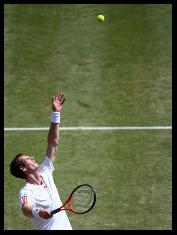 After four consecutive Djokovic-Nadal finals, fortunately some refreshing change, but only in some sense because Federer and Murray had already played two major finals before, however it happened in New York and Melbourne (funny coincidence – they never met beyond finals at majors) #. It only confirms how amazingly tight is the peak of men’s tennis consisted of four excellent players. There hasn’t been a Grand Slam final without at least one of them since Australian Open 2005 (!), when Marat Safin dismissed Lleyton Hewitt.
There has been an enormous amount of pressure put on Murray’s shoulders for many years at Wimbledon, but the 25-year-old Scot had obtained a required experience in three lost major finals to start another final in front of the home audience in a good style. No sign of hesitation in his initial hard strokes from both wings could intimidate a bit the 16-time Grand Slam champion. The level of tennis in the first two sets was astonishing, both guys displayed a rich arsenal of mixed rotations and rapid, flat shots from all angles of the court. Stats of the final.
Murray jumped into a 2:0* (deuce) lead when Federer got into the final and had a mini-set point at 4:3 – “the eternal No. 4” played a deep backhand-volley underneath the level of the net-cord to force Federer’s lob error. The Scot broke in the 9th game to clinch the set with a bunch of good serves. It’s admirable how many times during the fortnight he dealt very well with tight sets… Unfortunately for his fans it wasn’t a case in the 2nd set. Murray was winning his service games much more easier. He could break Federer twice: first at 2-all – Federer fought off a double break point with a smash and service winner. At 4:4, Murray had two mini-set points, and really great chance to convert the first opportunity – sent an easy backhand long, Federer withstood the second threat again with a smash. *5:6 (30/0), a tie-break seemed inevitable. Murray served a ball which could give him an ace and comfortable ’40/0′ but it called ‘out’ (Federer already moved himself to change the boxes) and the 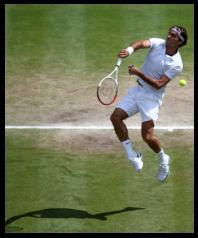 momentum shifted. The Scottish player made two errors, and Federer showed his magic at 30-all winning another two points with brilliant volleys, transforming in those rallies the defense onto the offense in a split second with crucial inside-out forehands. Ivan Lendl‘s face blushed in that moment (he was sitting almost the entire match in the same pose covering the mouth with fingers of his left hand). Apparently he knew the exceptional chance of his pupil would irretrievably evaporate.
The Swiss led 40/0 in the 3rd game of the 3rd set when heavy rain fell and the roof was activated – the final changed its conditions from outdoor to indoor 39 minutes afterwards. Nothing indicated that 6th game could turn into – perhaps – the longest game of this year’s event. Murray led 40/0 and Federer played a nonchalant backhand return – it was a clean winner, and the finalists were caught in a 20-minute marathon game consisted of 10 deuces, Murray found himself on the ground three times in that game, every time losing points, he also threw his racquet (softly) the only time during the fortnight, and finally lost his serve despite 7 game points, which was decisive for the final outcome. Federer was more and more relaxed whilst Murray’s fitness seemed suspicious, it’s not a matter of his body language which often is deceptive, simply the average speed & accuracy of his 1st serve dropped, and loose errors crept into his game. Federer made a crucial break at 2:2 in the 4th set with a beautiful cross-court backhand passing-shot. During the last change of ends, Murray received a huge support from the crowd chanting “Mur-Ray, Mur-Ray!!”. He opened the last game with a successful backhand passing-shot, but Federer got quickly the next three points and converted the second match point as Murray’s diagonal passing-shot landed just by inches outside the near sideline. The Swiss 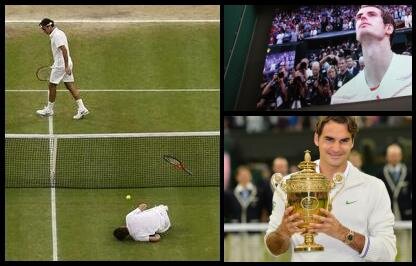 enjoyed his big success falling on grass. It’s his 17th Grand Slam title, 7th Wimbledon, which means he equals Pete Sampras‘ record and breaks a record of the American for the most weeks spent at No. 1 ## Murray for the first time in career loses three straight finals, and makes a new record (infamous one) – the most major finals played without a title ### He was very emotional during the ceremony, he almost cried when the crowd was trying to encourage him to say a few words. On the post-match conference he said: “Today [was] pretty hard, because you’re playing in front of a [British] crowd like that. The atmosphere was unbelievable, one of the best I’ve played in. [My] whole family had come to watch. So, yeah, it’s tough.” adding words full of respect towards Federer: “He could be sitting on 20 Grand Slams [but for] one point or a couple inches here or there. So he’s still playing great tennis. I don’t think you get to [World] No. 1 unless you deserve it.” The Swiss maestro stated: “This year, I guess, I decided in the bigger matches, to take it more to my opponent instead of waiting a bit more for the mistakes. This is, I guess, how you want to win Wimbledon, by going after your shots, believing you can do it, and that’s what I was able to do today. It’s special.” Now the best players in the world have three weeks off only to play ‘Wimbledon-2’, so the Olympic games at the same venue 🙂
Doubles final:
J.Marray/F.Nielsen d. (5)R.Lindstedt/H.Tecau 4-6, 6-4, 7-6(5), 6-7(5), 6-3
# Pairs to play in three (or more) different major finals (record of those finals in parenthesis):
4 – Novak Djokovic vs. Rafael Nadal (3-2)
3 – Mats Wilander vs. Ivan Lendl (3-2, never played at Wimbledon)
3 – Pete Sampras vs. Andre Agassi (4-1, never played final in Paris)
3 – Rafael Nadal vs. Roger Federer (7-2, never played in New York)
3 – Roger Federer vs. Andy Murray (3-0, never played in Paris)
## Most Wimbledon finals:
8 – Roger Federer (7 wins – 1 loss)
7 – Pete Sampras (7-0), Boris Becker (3-4)
6 – Bjorn Borg (5-1), Jimmy Connors (2-4)
5 – John McEnroe (3-2), Rafael Nadal (2-3)
Most weeks at No. 1:
1. Roger Federer & Pete Sampras – 286 *
3. Ivan Lendl – 270
4. Jimmy Connors – 268
5. John McEnroe – 170
* Federer has guaranteed overcoming Sampras’ record
### Most major finals not having won a title:
4 – Andy Murray (2008-12)
3 – Tony Roche (1968-70) *
2 – Steve Denton (1981-82), Miloslav Mecir (1986-89), Cedric Pioline (1993-97), Todd Martin (1994-99), Alex Corretja (1998-01), Mark Philippoussis (1998-03), Robin Soderling (2009-10)
* Roche won Roland Garros in the pre-Open era (1966)
Posted in Tournaments
1 Comment
Wimbledon – semifinals
2nd semifinal:
(4)Andy Murray d. (5)Jo-Wilfried Tsonga 6-3, 6-4, 3-6, 7-5 [2:47 h]
Not facing one out of three giants of the modern game in a Grand Slam semifinal it’s a unique opportunity, so it was a huge chance for both players to reach the final of the most important tournament in tennis. For Murray it was 4th consecutive semifinal attempt in London, for Tsonga second in a row. The roof had been open after the first semifinal, rain didn’t fall and the entire match was played outdoors. Jo-Wilfried is very tough to 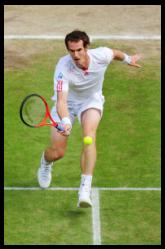 break on grass, en route to the semifinal he was broken only four times, but Murray is one of the best return players in the world, perhaps the best on grass, and managed to break Tsonga four times as well. The Scot showed his amazing defensive skills as early as in Tsonga’s opening service game when he returned-in a couple of bombs and made one incredible backhand passing-shot. The match was under his control through the first two sets, Tsonga was playing more aggressively than in his previous matches (there were sequences of constant serve-and-volley attacks), but it wasn’t efficient enough until the 3rd set when Murray had a “nap” for about 10 minutes, and the Frenchman established a 3:0 lead which was vital in that set despite Murray’s pursuit. Murray “woke up” after the first point of the 4th set and he was trying to encourage himself after almost every winning point. He built a *3:1 (30/30) lead – in that moment Tsonga manifested his unpredictability getting two important points thanks to one-handed backhands. At 4:3 Murray squandered two mini-match points, falling on the ground on both occasions! It could have been a turning point because in the following game Tsonga had a double mini-set point – Murray survived it with two unreturned services, the second one after casual 2nd serve – Tsonga risked a forehand return and missed. As I mentioned after Murray’s match against Ferrer, the Scot always wins 4th set tie-break, so he was quite relaxed when he held his service game to lead 6:5. Tsonga helped a bit in the last game of the match producing three unforced errors… Double match point: good serve, Tsonga goes to the net, Murray passes with a forehand. The ball is called ‘out’, but both players seem to know the ball was good which confirms Murray’s challenge. Tsonga congratulates hugging Murray, who has tears in his eyes. For the time being he proves that deserves No. 4 in the world, however, if he wants to finally move further (in the end of the season) he needs to beat Federer on Sunday… It’s the end of the 74-year-old drought for the British tennis in Wimbledon men’s finals (Bunny Austin was outplayed by Don Budge in 1938). In the Open Era the British fans suffered nine semifinal defeats of their favorites:
Roger Taylor (1970, 73)
Tim Henman (1998-99, 2001-02)
Andy Murray (2009-11)
1st semifinal:
(3)Roger Federer d. (1)Novak Djokovic 6-3, 3-6, 6-4, 6-3 [2:19 h]
It’s a special time at the top of the men’s tennis, almost every match involving two out of three best players in the world has more at stake than just beating an arch-rival to get a final or a trophy. This time Federer entering the court, had a chance to regain the top spot (he has to win also the final to do it) tying Pete Sampras‘ record of the most weeks on No. 1 and become the first man to play eight Wimbledon finals; Djokovic in turn, could equal Nadal’s accomplishment of reaching five consecutive Grand Slam finals (it’s something even Rod Laver had not done in the Open era; Federer played ten in a row!). Anyway they’ve created a common new record for the most meetings at majors – 11 #.
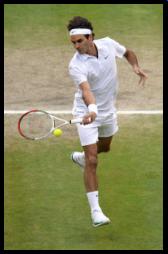 The weather afternoon was bad which forced the officials to close the roof. Tim Henman and Boris Becker commentating this match for a TV sport channel, agreed that indoor conditions would favor Federer, and they were right. The level of play disappointed, especially in the opening, reflex two sets. “First blood” came in the 6th game as serving Djokovic dived unsuccessfully at 30-all. Trying to save the first break point he missed a backhand and the set was pretty much over. The Serb finally read Federer’s serve a couple times in the 2nd game of the 2nd set and broke him to 15 producing aggressive ground-strokes. The crowd waited until the 6th game of the 3rd set to see the first and one of very few excellent rallies – it was a break point for Federer, Djokovic won the point and showed first emotions. He had a mini-set point at 4-all but Federer responded with three service winners in a row. The crucial point of the match occurred with Djokovic serving to stay in the set in the following game. He was 15/30 down and played too cautiously from a very good position, Federer defended himself with a moon-lob and the Serb missed an overhead. He saved the first set point but on the second one, Federer outmaneuvered his opponent and finished the point with a smash. Apparently the tense 3rd set cost Djokovic a lot mentally because he made a few untypical baseline rallies at the beginning of the 4th set and found himself quickly at 0:3 down, which meant he had lost five consecutive games. Federer was fresh and his serve was working amazingly. Even when the Serbian player came back from a triple break point at 1:4 and two points away from defeat at 2:5, Federer didn’t show any sign of uncertainty, and finished the semifinal with two solid service winners. I think it’s worth underlying he got many points throughout the match directly after 2nd serve, IMO it was something what differed them the most. “If he wins and becomes No. 1, it’s going to be well deserved,” Djokovic said. “He’s played fantastic this year. He’s been so consistent. If he wins, he wins. There’s nothing I can do about it. The best player will win this tournament. I’m out.”
# Most matches at majors:
11 – Roger Federer vs. Novak Djokovic (6-5)
10 – Rafael Nadal vs. Roger Federer (8-2)
10 – Ivan Lendl vs. John McEnroe (7-3)
Posted in Tournaments
Leave a comment