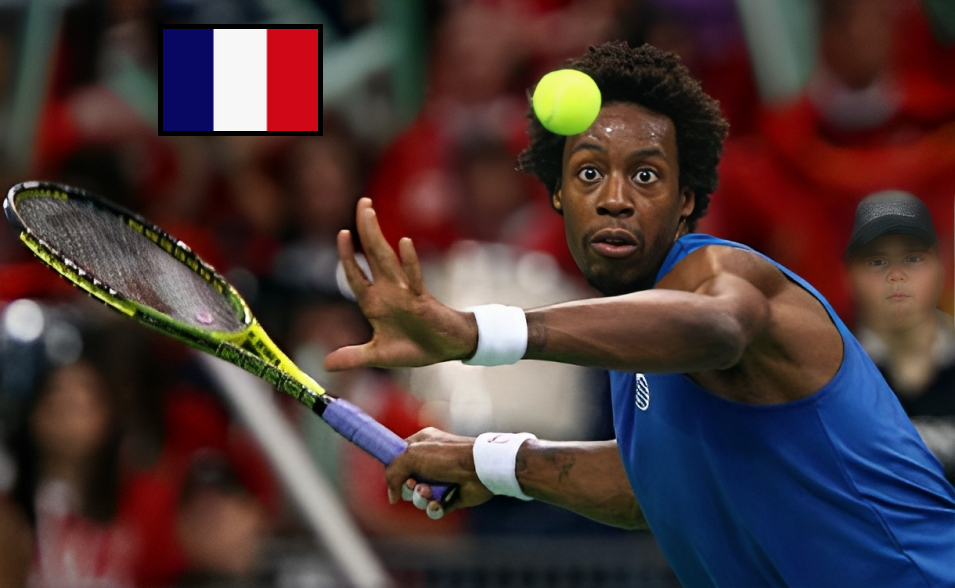
Gaël Monfils
Born: September 1, 1986 in Paris
Height: 1.93 m
Plays: Right-handed (two-handed backhand)
“Every circus needs its clown” – I read this sentence somewhere about Ilie Năstase, the greatest Romanian player in history. Năstase won two Slams and four Masters titles, and was No. 1 in the world for a while. Perhaps his behavior prevented him from achieving more, but he is still one of the greatest players of the 1970s. Gaël Monfils, the biggest clown of the ATP among those born in the 1980s, never even played a major final (reaching two semifinals: at the French Open and the US Open, and once coming within one point of reaching another). From the perspective of French hopes, he is a big disappointment alongside another super-gifted French boy also born in 1986, Richard Gasquet.
Their careers, however, took different paths: Gasquet began regularly playing against adults as a young teenager, while Monfils stayed on the junior circuit, becoming one of the most accomplished under-18 players in the entire Open Era. In 2004, he won three out of four junior majors, before Viktor Troicki defeated him in the US Open third round ending a 26-match winning streak (tennis didn’t see such a successful junior since Stefan Edberg in 1983).
Monfils’ transition to professional tennis was smooth; already in his ATP debut (via a wildcard), he reached the quarterfinals in Metz ’04. A few weeks later, he came through the qualifying rounds in Paris and, in the first round, ousted a very experienced former champion of the event, Thomas Enqvist. In his third main-level event, Monfils defeated the then French Open champion, Gastón Gaudio. It was obvious the kid had big potential, and the future was wide open.
I’d risk the thesis that the most important match in Monfils’ career actually occurred at the very beginning, when he lost to Novak Đoković in the first round of the 2005 US Open. Đoković “stole” Monfils’ spirit in that match. The young Serb was dehydrated, lying on the court and close to retiring, yet somehow found the enormous will to prevail and left the court a winner after a four-hour battle- despite winning 24 points fewer! Twenty-one years later, Monfils finished his career with a 0-20 (!) main-level record against the Serb, who turned into the greatest players in tennis history, while Monfils will be remembered at most as a “great athlete” – a simplified term, resulting from the fact that most people lack better ways to express degrees of adjectives. He was long-lived; that is beyond dispute.
Over the years, I became very critical of Monfils. Every player develops throughout their career – some slower, some faster – but Monfils remained fiercely defiant about changing his insufficient game style. He was known for his involvement in spectacular points… that meant nothing at the end of the day. Tennis is not ski jumping, where you receive additional points for style; the most important thing in tennis (in terms of success) is efficiency, a concept Monfils seemed to grasp very little. His so-called great athleticism didn’t impress me at all, especially given how many times he retired or gave walkovers to his opponents.
Knowing how flexible his wrist was and how he was able to accelerate the ball, especially from his right wing, it was painful to watch him over and over again run frantically toward the ball only to hit a forehand slice to prolong the rally instead of trying to finish it. He gave the impression that while on the run, pleasing the crowd with his movement mattered more to him than actually winning the point. Plenty of sliding, diving, and general theatrics – to no avail. Boris Becker used to dive a lot, but at the net, especially on grass, with a clear intention to win the point. Monfils, by contrast, used to dive at the baseline (even on hard courts!) when his chances of winning the point were at most 10%, while the risk of injury was multiplied.
He finished his very long career without a single Masters 1000 title, which is a serious failure after so many years on tour regularly participating in those events. He lost three finals, each time in front of a supportive crowd (Paris in 2009 and 2010, and Monte Carlo in 2016). Twice he lost to the greatest players, but once he was a slight favorite after playing the match of his life (in the ‘best-of-three’ format) in the semifinals. His demanding style of play likely contributed to his poor record in ATP finals (13-22). In my opinion winning Washington in 2016 is arguably his biggest title, though at the ATP 500 level he also triumphed twice in Rotterdam.
He drifted into retirement under quite unclear circumstances just after turning 40; it was later revealed he skipped two farewell events in France due to personal problems (divorcing from professional female player Elina Svitolina). He was an entertainer who left his mark on the two decades in which he was active, but he departed the scene without any significant triumph – twice he won singles rubbers in the Davis Cup finals (in 2010 and 2014), but ultimately those victories went in vain.
Career record: 588-360 [ 375 events ]
Career titles: 13
Highest ranking: No. 6
Best GS results:
Australian Open (quarterfinal 2016 & 22)
Roland Garros (semifinal 2008; quarterfinal 2009, 11 & 14)
US Open (semifinal 2016; quarterfinal 2010, 14 & 19)
This entry was posted in
Players. Bookmark the
permalink.


Activity: 2004 – 2026
Five-setters: 22-22 (50%)
Tie-breaks: 244-178 (58%)
Deciding 3rd set TB: 18-26 (41%)
Defeats by retirement: 26
Walkovers given: 9
Longest victory: Roland Garros ’11 (4R)… David Ferrer 6-4, 2-6, 7-5, 1-6, 8-6… 4 hours 7 minutes
Longest defeat: US Open ’11 (2R)… Juan C. Ferrero… 6-7, 7-5, 7-6, 4-6, 4-6… 4 hours 48 minutes
MP matches: 14-16
Two-point away matches: 7-12