Kei Nishikori
Born: December 29, 1989 in Matsue
Height: 1.78 m
Plays: Right-handed (two-handed backhand)
けい にしこり (Hiragana), 錦織 圭 (Kanji)… The best Japanese player in history, and one of the finest players of the 2010s; in terms of mental and technical ability, I rank him on the same level as Novak Đoković and Andy Murray. From my perspective, the serve was what ultimately separated the Japanese from the biggest titles collected by the Serb and the Scot. Nishikori was also somewhat unlucky in a broader sense, because with his skills he deserved at least one Masters 1000 title or an ATP Finals crown (he took part in four editions). Unfortunately for him, in the Masters 1000 finals he always ran into the greatest players in the world: twice Rafael Nadal (Madrid ’14, Monte Carlo ’18) and twice Đoković (Miami and Toronto in 2016).
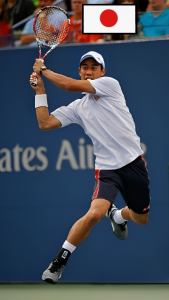 Nishikori had his clearest opportunity when he reached the US Open ’14 final, facing Marin Čilić, a player he had beaten several times before (including in New York). That year, however, the Japanese had already survived extremely demanding five-setters against Milos Raonic and Stan Wawrinka as well as a tricky four-setter against Đoković, and in the final he simply ran out of gas. Without the bronze medal he earned in Rio, Nishikori could easily be viewed as an underachiever. I praise that achievement higher than his ATP 500 titles obtained six times in four different cities (Memphis, Barcelona, Tokyo and Washington).
He was the youngest title-winner of 2008 and, in a sense, joined Đoković and Murray (both born in 1987) as well as Čilić and Juan Martín del Potro (both born in 1988). At the end of the 2000s he was the youngest player on the tour alongside the few-months-older Donald Young, who completely failed to fulfil his promise. For many years afterwards no younger player emerged who could seriously threaten the Big 4, until Alexander Zverev announced himself in 2017 as someone capable of conquering the biggest titles and toppling the established order. Nishikori’s potentially rapid development was stalled in 2009-2010 by elbow problems.
What I particularly appreciated about Nishikori was his ability to control the final outcome of matches. There were numerous occasions when he calculated that fighting for a particular set was pointless, or when he looked almost disinterested while returning, deliberately conserving energy for his own service games. He perfected this skill: many times he appeared physically drained, yet at the decisive moments he was still able to produce his best tennis. Short-term memory was another quality in his arsenal that I admired a great deal. Like Murray, he never seemed unduly disturbed after blowing a lead at the end of a set; even when he lost a 5:3* (40/30) advantage and found himself at *5:6, you could still sense that the odds in the tie-break remained in his favour. He played two five-setters against Murray, once he came on top.
From a technical standpoint, one aspect that always struck me as slightly unusual was Nishikori’s return stance. He placed his left leg well in front of his body, which appeared to restrict his balance when playing the backhand – his strongest shot and often more reliable than his forehand. My only explanation is that this stance originated in his early years, when his forehand was clearly the better wing and the servers he faced were far less powerful than those of his professional prime. At that stage the position allowed him to attack serves with a heavily topspin forehand (the teenage Nishikori hit the forehand with considerably more spin). At some point in his development no one thought to adjust the footwork, even though it cost him fractions of a second when opponents served down the T on the deuce court or wide on the ad court. 2019 was his last strong season – he won the title in Brisbane and reached three major quarterfinals – after which a long succession of injuries, beginning with elbow surgery later that year and continuing with a major left-hip operation in 2022 (he didn’t play that year at all) plus recurring knee, back and shoulder problems, steadily undermined his physical reliability and eventually led him to announce his retirement at the end of 2026 after several years of irregular appearances.
Between Shuzo Matsuoka (born 1967) and Nishikori there was only one Japanese player who regularly appeared at the majors – Takao Suzuki (born 1976) – yet his results were very modest. Nishikori ushered in a distinctly better era for Japanese tennis. In the last years of his career he was joined at the biggest events by Yuichi Sugita (born 1988), Yasutaka Uchiyama (born 1992), Taro Daniel (born 1993) and Yoshihito Nishioka (born 1995). None of them, however, has managed to reach the second week of a Grand Slam.
Career record: 452-232 [ 239 events ]
Career titles: 12
Highest ranking: 4
Best GS results:
Australian Open (quarterfinals 2012, 2015-16 & 2019)
Roland Garros (quarterfinals 2015, 17 & 2019)
Wimbledon (quarterfinals 2018-19)
US Open (runner-up 2014; semifinalist 2016 & 2018)
Olympic Bronze medallist (Rio 2016)
This entry was posted in
Players. Bookmark the
permalink.


Activity: 2007 – 2026
Five-setters: 29-8 (78%)
Tie-breaks: 144-101 (59%)
Deciding 3rd set TB: 15-8 (65%)
Defeats by retirement: 21
Walkovers given: 6
Longest victory: Aussie Open ’19 (4R)… Pablo Carreño Busta 6-7, 4-6, 7-6, 6-4, 7-6… 5 hours 5 minutes
Longest defeat: Davis Cup ’16 (1R)… Andy Murray… 5-7, 6-7, 6-3, 6-4, 3-6… 4 hours 54 minutes
MP matches: 11-7
Two-point away matches: 14-1 (!)