Points won by each set: | 29-36, 31-18, 32-20, 33-36, 41-33 |
Points won directly behind the serve:
26 % Schalken – 37 of 142
20 % Nieminen – 35 of 167
Being strongly supported the crowd, Nieminen led *3:0 (30/0) in the 5th set when he netted a FH passing-shot from an easy position. He had two game points in that game anyway, at one of them Schalken struck a perfect FH return which landed on the sideline. Nieminen also led *3:2 (40/15) – he squandered six game points in total to get his fourth game in that set, and ultimately lost six games in a row (in the 4th set he led 4:0* before 5:4, 30-all) which makes that Schalken’s comeback one of the most impressive in the Open Era as far as fifth sets of the championship matches are concerned. The final outcome can be surprising for someone with knowledge that Nieminen was a five-set specialist while Schalken was known as an unreliable player in fifth sets, yet when they met in Sweden the circumstances were quite specific – for the 20-year-old Nieminen [103, qualifier] it was just his second main-level event, his first five-setter while five years older Schalken [40] had already played much longer five-setters (including a marathon against Philippoussis – one of the longest fifth sets in tennis history). When they met, the Dutchman not only had much more impressive experience, he also had played three matches fewer that week which allowed him to preserve more energy when it mattered the most. The following week, Schalken would play his best Masters 1K event, in Paris; having eliminated Kuerten and Roddick, he lost a dramatic encounter to Vinciguerra though (6-2, 6-7, 6-7). Nieminen would win another six five-setters to finish his career with one of the most respectable records (21-11).
Schalken’s route to his 6th title:
1 John van Lottum 6-1, 6-3
2 Wayne Arthurs 6-4, 6-3
Q Jan Vacek 6-3, 7-6(3)
S Guillermo Canas 6-4, 6-2
W Jarkko Nieminen 3-6, 6-3, 6-3, 4-6, 6-3
☆ The 20-year-old Jarkko Nieminen registered the first final appearance by a Finn in almost 20 years when Leo Palin lost his final to Ricky Meyer in Sofia, Bulgaria on December 20, 1981. Nieminen played his just second main-level event in Stockholm ’01, it helped him to become a Top 100 player. Afterwards he kept the position of a regular ATP player for ~13 years, no doubt he’s the best Finn in history, but he’s an underachiever in my mind. He was lefty, eager to change tactics if required, with ‘never say die’ attitude which helped him to win many “lost” matches; he was0 easily adapted to different surfaces, hence I think he had in himself the ability to shock the tennis world once claiming a Masters 1K title or playing a Slam semifinal at least. He never even played a semifinal in the biggest events, four times losing Masters 1K quarterfinals, and thrice quarterfinals at majors (US Open ’05, Wimbledon ’06, Aussie Open ’08). His highest ranking no. 13, just 2-11 record in the ATP finals (never at the ATP 500 level), so no problem to indicate Sydney ’12 as his biggest title, it could have been sweeter three years before because in the semifinals he ousted Ðoković. At the Challenger level his record in the finals is much better (10:4).

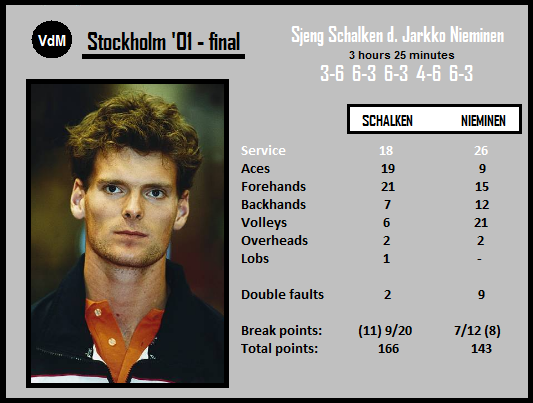
Points won by each set: | 29-36, 31-18, 32-20, 33-36, 41-33 |
Points won directly behind the serve:
26 % Schalken – 37 of 142
20 % Nieminen – 35 of 167
Being strongly supported the crowd, Nieminen led *3:0 (30/0) in the 5th set when he netted a FH passing-shot from an easy position. He had two game points in that game anyway, at one of them Schalken struck a perfect FH return which landed on the sideline. Nieminen also led *3:2 (40/15) – he squandered six game points in total to get his fourth game in that set, and ultimately lost six games in a row (in the 4th set he led 4:0* before 5:4, 30-all) which makes that Schalken’s comeback one of the most impressive in the Open Era as far as fifth sets of the championship matches are concerned. The final outcome can be surprising for someone with knowledge that Nieminen was a five-set specialist while Schalken was known as an unreliable player in fifth sets, yet when they met in Sweden the circumstances were quite specific – for the 20-year-old Nieminen [103, qualifier] it was just his second main-level event, his first five-setter while five years older Schalken [40] had already played much longer five-setters (including a marathon against Philippoussis – one of the longest fifth sets in tennis history). When they met, the Dutchman not only had much more impressive experience, he also had played three matches fewer that week which allowed him to preserve more energy when it mattered the most. The following week, Schalken would play his best Masters 1K event, in Paris; having eliminated Kuerten and Roddick, he lost a dramatic encounter to Vinciguerra though (6-2, 6-7, 6-7). Nieminen would win another six five-setters to finish his career with one of the most respectable records (21-11).
Schalken’s route to his 6th title:
1 John van Lottum 6-1, 6-3
2 Wayne Arthurs 6-4, 6-3
Q Jan Vacek 6-3, 7-6(3)
S Guillermo Canas 6-4, 6-2
W Jarkko Nieminen 3-6, 6-3, 6-3, 4-6, 6-3
Serve & volley: Schalken 5/7, Nieminen 3/5
☆ The 20-year-old Jarkko Nieminen registered the first final appearance by a Finn in almost 20 years when Leo Palin lost his final to Ricky Meyer in Sofia, Bulgaria on December 20, 1981. Nieminen played his just second main-level event in Stockholm ’01, it helped him to become a Top 100 player. Afterwards he kept the position of a regular ATP player for ~13 years, no doubt he’s the best Finn in history, but he’s an underachiever in my mind. He was lefty, eager to change tactics if required, with ‘never say die’ attitude which helped him to win many “lost” matches; he was0 easily adapted to different surfaces, hence I think he had in himself the ability to shock the tennis world once claiming a Masters 1K title or playing a Slam semifinal at least. He never even played a semifinal in the biggest events, four times losing Masters 1K quarterfinals, and thrice quarterfinals at majors (US Open ’05, Wimbledon ’06, Aussie Open ’08). His highest ranking no. 13, just 2-11 record in the ATP finals (never at the ATP 500 level), so no problem to indicate Sydney ’12 as his biggest title, it could have been sweeter three years before because in the semifinals he ousted Ðoković. At the Challenger level his record in the finals is much better (10:4).