
My eBook
Categories
-
Recent Posts
September 2026 M T W T F S S 1 2 3 4 5 6 7 8 9 10 11 12 13 14 15 16 17 18 19 20 21 22 23 24 25 26 27 28 29 30
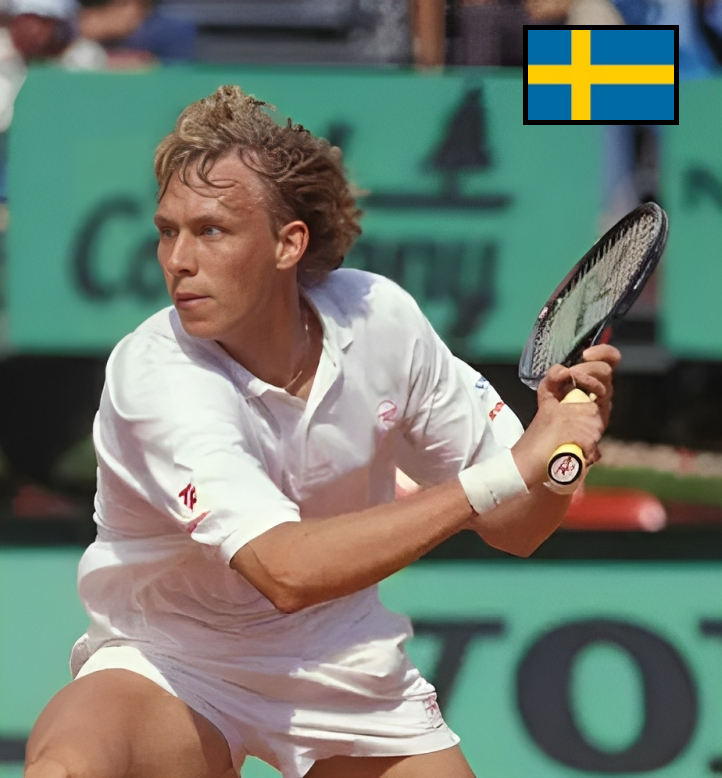
Jonas Svensson
Born: 21 October 1966 in Göteborg (Västra Götaland)
Svensson, my initial favorite player, stood out amidst the incredible generation of Swedish players born in the 1960s in terms of game-style. While most of his compatriots were characterized as solid baseliners with two-handed backhands (unlike Stefan Edberg, a one-handed serve-volleyer), Svensson didn’t conform to neither of two basic categorization of players at the time. His
Career record: 258-204 [ 205 events ]
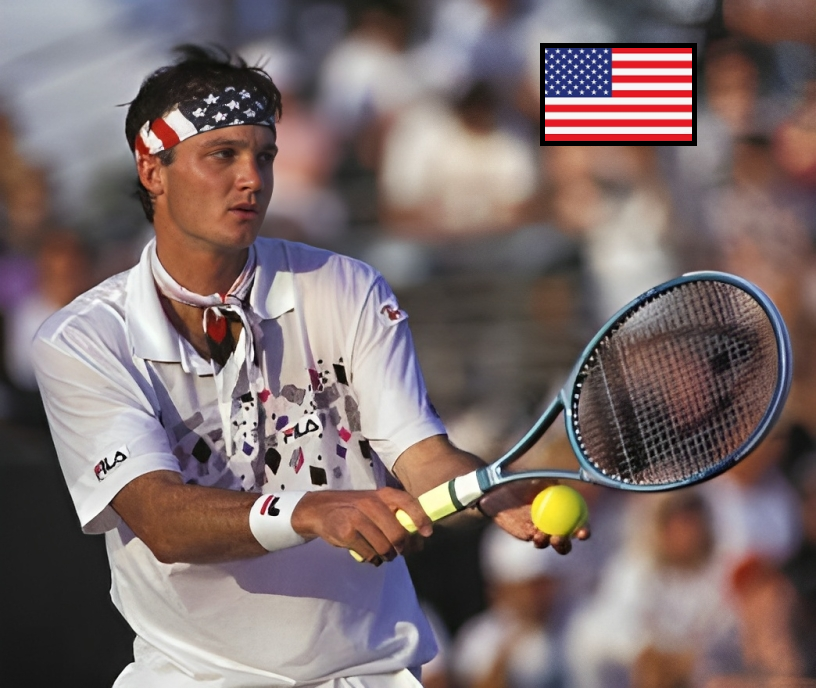
David Wheaton
Born: June 2, 1969 in Minneapolis (Minnesota)
Height: 1.93 m
Plays: Right-handed (two-handed backhand)
A man often seen sporting either caps or headbands adorned with the US flag, Wheaton, with flashing eyes before his serve, stood as one of the most intriguing players born in the late 60s, and the elder statesman in the golden era of American young talents – a generation that shook the tennis world in the late ’80s and early ’90s. He appeared destined for a major final at least, having already reached two major quarterfinals at different venues as a newbie. His journey to the Key Biscayne ’91 final and Wimbledon semifinal the same year, included gripping victories on Centre Courts against Stefan Edberg (2-0), Ivan Lendl (3-1) and (twice) Andre Agassi, who became one of Wheaton’s most formidable early rivals (despite Wheaton leading 3:1 after Wimbledon ’91, he lost their subsequent five meetings)… Todd Martin, not Wheaton, secured the anticipated results, “stealing” Wheaton’s destiny in their fourth round at 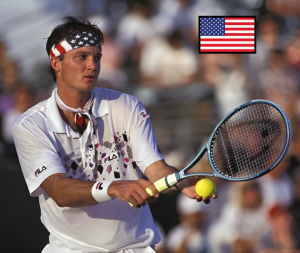 Wimbledon ’93, in a match where Wheaton squandered a two-sets-to-one lead and a 3:0 advantage in the fourth set with a double break. This loss on grass – considering Wheaton’s prowess as a big server – seemed improbable. Although both were Top 40 players at the time, this match heralded Martin’s meteoric ascent while signalling Wheaton’s gradual decline. Wheaton had become a victim of his unexpected prior successes, particularly the Compaq Grand Slam Cup in Munich. The tournament, which drastically altered his life, saw Wheaton earning two and a half million dollars in just seven matches (semifinalist in 1990 and champion the following year)!
Wheaton once expressed: “I hope the money won’t change me. I’ve been brought up with a certain set of values and ethics. I don’t think I’m going to change. I’m not a materialistic person.” However, Wheaton later admitted that the astonishing wealth ($3M) earned between December ’90 and December ’91 had indeed altered him. It not only diminished his dedication and motivation to still train rigorously but also distanced him from many good friends as he embraced a life of luxury. His realization came later, acknowledging that wealth did not equate to personal fulfillment or peace. It was two years after the enormous financial success, through embracing Christianity, that Wheaton found lasting hope and joy.
Post his spiritual awakening, Wheaton encountered two average years on the tour. Before it happened, during the 1993 majors, he notably stunned Michael Chang twice (Australian Open and Wimbledon), leading 6:1 in their rivalry before Chang easily won their subsequent four matches. In an attempt to revive his career as a new-born Christian, Wheaton altered his service motion (longer preparation, shorter ball toss), almost reaching the Aussie Open ’95 quarterfinals; his defeat to Andrei Medvedev, losing 8-10 in the 5th set despite holding a breakpoint at 3:1, marked the conclusion of his elite player status.
Injuries plagued his performances – a hip injury in 1994, a right Achilles injury in 1996, an operation to remove a bone spur under his Achilles’ tendon in 1997, and a hurt medial collateral ligament in his elbow in 1998. Reflecting on his career, Wheaton admitted: “My biggest disappointment is looking back and thinking I could have done better if I had a better perspective on life and tennis. At the same time, I learned valuable lessons through the ups and downs of tennis that continue to guide me today.”
Recognized as a big server during his prime, Wheaton’s skill set, particularly his backhand and half-volley, set him apart. Despite his patriotic displays, Wheaton’s impact on the success of the Davis Cup team in the years 1990-92 was none (however, in 1991 he led his country to the Hopman Cup final) – ranked as the fifth young American, he wasn’t appointed to the US ties. His dreamy 1993 representation for the United States resulted in a loss to Mark Woodforde in four sets, contributing to the USA’s 1-4 defeat to Australia at Kooyong on grass.
Noteworthy moments in Wheaton’s career include edging the best player of the 80s, Lendl 5-3 in their rivalry, while finding Pete Sampras, the most dominant player of the following decade, as his toughest opponent. Despite losing all eight official meetings against Sampras, Wheaton remarkably defeated him twice in straight sets within a week in an exhibition event in Atlanta ’91 – first in a ’round-robin’ match, and then in the semifinal. Additionally, Wheaton holds a negative record for the most consecutive sets lost in tie-breaks (six): in 1989, trying to crack the Top 100, he lost 6-7, 6-7 in Bristol, 6-7, 6-7, 6-7 in his Wimbledon debut, and lost 6-7 again at his another appearance (Washington), but the subsequent two sets he quickly won.
Career record: 232–191 [ 193 events ]
Career titles: 3
Highest ranking: No. 12
Best GS results:
Australian Open (quarterfinal 1990)
Wimbledon (semifinal 1991)
US Open (quarterfinal 1990)
Grand Slam Cup champion ’91
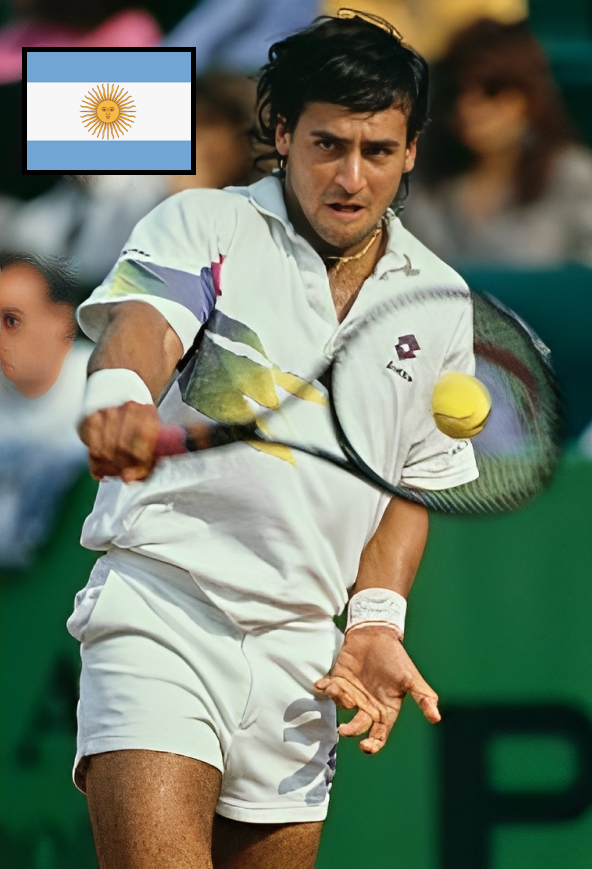
Alberto Mancini
Born: May 20, 1969 in Misiones (Mesopotamia)
Height: 1.79 m
Plays: Right-handed
At the time (from mid- to late 80s) when two icons of Argentine tennis, Guillermo Vilas and José-Luis Clerc, were nearing the end of their careers, three new promising Argentinian players emerged on the scene: Martín Jaite (b. 1964), followed shortly by five years younger Mancini and Guillermo Pérez-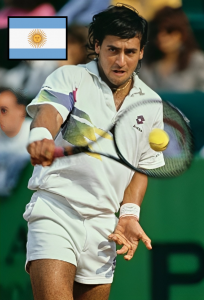 Roldán. Among these three, Mancini showed the most potential, but his progress was unexpectedly halted at the age of 20. Despite his young age, Mancini, with his heavy top-spin style (he looked like a right-handed version of Thomas Muster), stunned the tennis world in the Spring of 1989, securing victories in two significant clay-court tournaments, then not yet named ‘Mercedes Super 9’ – Monte Carlo and Rome. His triumphs were especially remarkable given the caliber of opponents he faced in the (semi)finals and the manner in which he defeated them: after destroying the best player of ’88 Mats Wilander in the semifinal, Mancini overcame Boris Becker in a tight four-setter and a few weeks later Andre Agassi in the five-set Roman final, where he saved a match point in the fourth set. In Italy, Mancini enjoyed a support like an Italian, at the time Roberto Mancini – who was looking like a cousin at least – was a striker in the Italian national team.
He expressed his joy in Monaco, saying, “To beat Wilander and Becker on center court in Monte Carlo… it’s like a dream. I’m very happy.” Mancini’s success put him among the contenders for the French Open title. However, he struggled against the inclement weather and Stefan Edberg‘s serve-and-volley style in the quarterfinals, as the Swede had previously defeated him in Munich after his Monte Carlo victory and repeated the feat in Paris. Although Mancini had already clinched three titles in his first three ATP finals, two big ones, he didn’t add to his tally in five more finals, including prestigious Stuttgart, and two ‘Mercedes Super 9’ events in Rome, and Key Biscayne on hardcourts, where he wasn’t expected to shine. He was never a favorite in any of the eight ATP finals he participated in. Injuries and inclination to partying, forced him into retirement at just 25, a year after the disappearances of Jaite and Pérez-Roldán (they led Argentina to the World Team Cup ’89 final; Mancini didn’t participate in that team event as he was preparing to conquer Paris). Mancini was a part of a trend in the late 80s/early 90s leading to specialisation in focusing on the red surface; he was regularly skipping the grass-court sub-season. After reaching the Indian Wells ’93 quarterfinal, Mancini was losing the first rounds in majority of his appearances for more than a year. In 1996 he came back only to play a few Challengers. He later became the captain of the Argentine Davis Cup team (two finals: 2006 and 2008). A piece of trivia: he faced his compatriot Pérez-Roldán five times, losing their first two matches and winning the subsequent three. In the early 20s he coached Fabio Fognini, marking almost two decades since his own noteworthy coaching success with Guillermo Coria. Mancini unexpectedly went beyond the Latin sphere of influence, and the level he reached as a player, becoming a coach of a German – “second league” I’d say – player, Daniel Altmeier in 2023.
Career record: 134–132 [ 121 events ]
Career titles: 3
Highest ranking: No. 8
Best GS result:
Roland Garros (quarterfinal 1989)
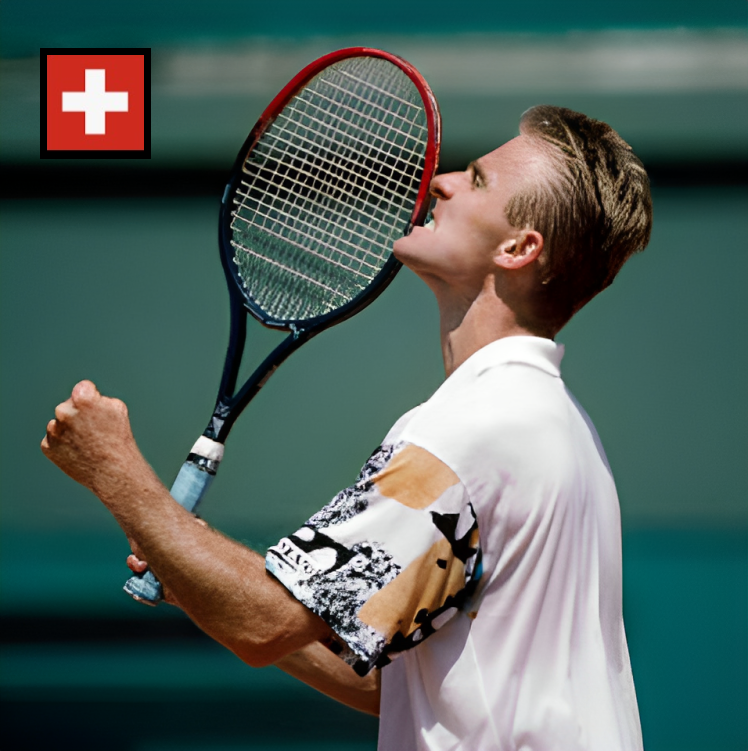
Jakob Hlasek
Born: November 12, 1964 in Praha (Czechoslovakia)
Height: 1.87 m
Plays: Right-handed
Born as Jakub Hlásek, his parents fled with him from their country to the French-speaking area of Switzerland during the Warsaw Pact invasion of Czechoslovakia. Richard Krajicek‘s parents (Krajíček) did the same, but Krajicek was born in the Netherlands three years after those events. On paper, Hlasek displayed similar skills to Stefan Edberg and Pat Cash. These three players, born in the mid-60s, were more or less the same height, right-handers, and serve-and-volleyers. They possessed a more stable backhand than forehand, and their technique became obsolete in the second half of the ’80s, as they were using just one grip for all strokes, characteristic of wooden racquets.
One significant difference between Edberg and the other two players was that the Swede had better control over all basic elements of tennis craftsmanship. Cash and Hlasek especially, both had a faster first serve, but Edberg’s serve could be considered overall better, given his distinctive second delivery. Cash enjoyed a much better career at Slams than Hlasek, managing longer distances adeptly. However, Hlasek (only one major quarterfinal, in Paris ’91), largely uninjured, in terms of events played, enjoyed a much prolonged career than Cash. Ultimately, each collected five Grand Prix/ATP titles. The difference between Edberg and Hlasek was particularly visible when they were facing each other, it happened as many as 16 times and the Swiss got only one victory. Nonetheless, the Swede needed deciding tie-breaks thrice.
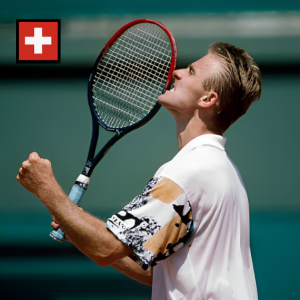 In the initial years on the tour, Hlasek held a solid Top 50 position. However, in the latter part of the ’88 season, a transformative shift occurred when he switched his racquet from Kneissl “White Star Twin” to Puma “Becker Winner” (photo) – a racquet with a distinct futuristic shape and coloristic – and underwent a change in hairstyle to a classic crew cut; this alteration bore a striking resemblance to Ivan Drago, a fictional character from the widely popular film at the time “Rocky IV”. These changes seemed to spark a remarkable transformation in his performance, as he exhibited an awesome level of play, triumphing in matches across four continents, almost week after week.
It all started in New York at the US Open, where he reached the fourth round and played a competitive 4-setter against the then-best player in the world, Ivan Lendl. After a week’s break, he flew to Asia (South Korea) for the Olympics to win two matches, returned to Europe, rested a bit to begin in October his superhuman effort: five indoor events within six weeks, playing four or five matches in each of them (!); after the final in Basel and three semifinals in four weeks (Toulouse, Paris, Antwerp-exho), he secured his maiden title at Wembley. Directly from England, he flew to Africa (Johannesburg), winning another trophy, this time outdoors, only to play the third successive final, in Europe (Brussels, indoors) the following week.
All these events allowed him to jump from No. 29 to No. 8, which meant that one day after being a runner-up in Belgium, he joined the top eight players of the world in New York in the season-ending championships. Despite the astonishing intensity of his appearances, he stunned Lendl in his first match at the “Masters,” trailing 2:4 in the 3rd set, won two more matches, only to be beaten in the semifinal by Boris Becker after two tie-breaks. Between his two New York events, Hlasek achieved a 32-7 record (35-8 inc. Antwerp), while in the first three quarters of the season (being injured in the first quarter), he had just 17-8.
Like many players before and after, Hlasek remained a one-season man, or more precisely, a man of an amazing five-month period. He transferred his great form of Autumn ’88 to the first two months of 1989, triumphing in Rotterdam, reaching the Lyon final, and narrowly losing the opening, extraordinary match in Dallas (WCT Finals) to Lendl. That bitter loss basically concluded an interval between tournaments on US hardcourts when he was winning more matches than any other player on the tour. He was never the same in the aftermath.
Hlasek, a player of two decades, defeated at least once all the greatest players of the late ’80s and early ’90s, having the best Head-to-Head against them, facing John McEnroe, stunning him twice 7-6 in the third sets at Paris-Bercy. In a trivia note, Hlasek is the only Open Era player to lose two gruelling five-setters within a few days. It occurred in the Davis Cup tie (Euro-Zone) between Switzerland and Israel in 1986. On a Friday in St. Gallen, Hlasek was defeated on carpet by Amos Mansdorf 2-6, 6-1, 3-6, 6-3, 10-12. Two days later, he suffered a heartbrekaing loss to Shlomo Glickstein 3-6, 6-1, 6-8, 12-10, 9-11. Along with Marc Rosset, he helped Switzerland in advancing to the Davis Cup ’92 final where lost two matches, including the last one for the tie. Hlasek and Rosset triumphed that year at Roland Garros in doubles. Hlasek’s poor 12-20 record in five-setters (38%) explains why he performed below expectations at majors, despite his ability to be a dangerous floater in the ‘best of three’ format on all surfaces.
Career record: 432–330 [ 307 events ]
Career titles: 5
Highest ranking: No. 7
Best GS result:
Roland Garros (quarterfinal 1991)
World Team Cup 1996 champion
Hopman Cup 1992 champion
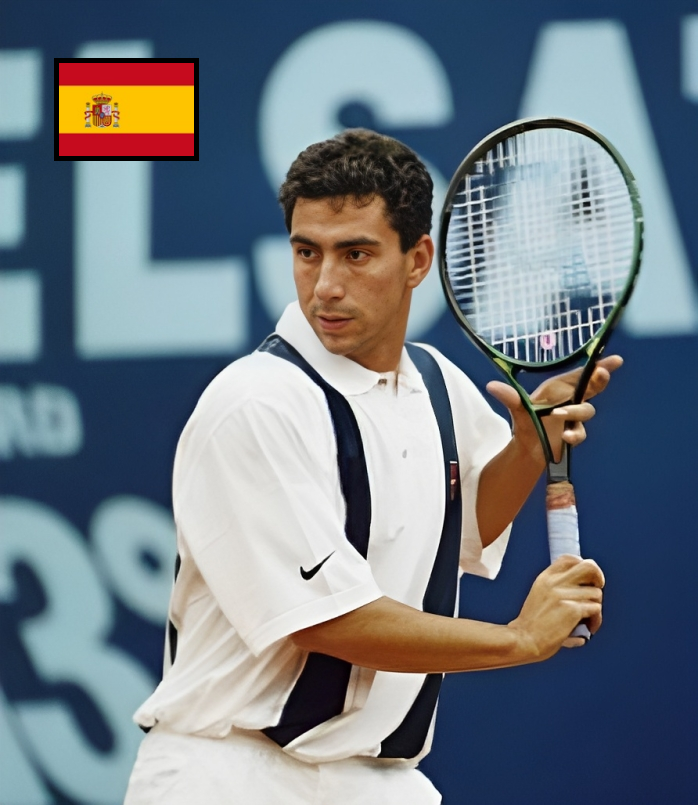
Albert Costa Casals
Born: June 25, 1975 in Lleida (Cataluña)
Height: 1.80 m
Plays: Right-handed
Spanish tennis witnessed the emergence of five promising young players in the mid-’90s: Alberto Berasategui, Àlex Corretja, Félix Mantilla, Albert(o) Costa (removed the “o” from his name in 1997), and Carlos Moyá. Initially, my expectations leaned towards Costa’s potential, but witnessing Moyá’s performance at the Aussie Open ’97 changed my perspective. Two years later, he claimed the World No. 1 spot, and in 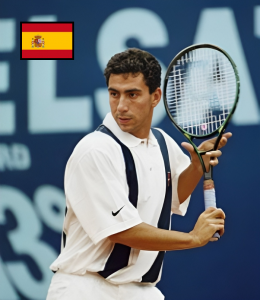 hindsight, it’s evident that he had the most stellar career among them. Costa (unrelated to Carlos Costa) appeared poised for multiple French Open triumphs, my belief stemmed from his three 5-set battles against Thomas Muster, who dominated clay in the years 1995-96. Despite almost toppling Muster at French Open ’95 in four sets (after defeating Jim Courier in Round 4), clinching the Kitzbühel title in the same year, and engaging in a tight 5-setter at Monte Carlo ’96 (leading 2:1 in that final), Costa surprisingly failed to secure even one quarterfinal berth in Paris during the second half of the ’90s: early losses in ’96 and ’97 to Francisco Clavet and Mark Woodforde were shocking, yet the ’98 loss to Marcelo Ríos, and ’99 to the same player, might be considered part of an unlucky draw.
Costa’s clay court prowess dwindled in the early 2000s. Although he wasn’t a favorite in the first three editions of the new millennium, there were missed opportunities. In 2000, he could have reached the semifinals but lost in four sets to Franco Squillari, despite three previous victories over him. The dramatic 5-set loss to Julien Boutter in 2001 marked another unfortunate early exit. However, in 2002, Costa finally fulfilled his Parisian destiny with first wrinkles on his face. Looking back, his journey to the title stands out. While his initial victories against Richard Gasquet and Nikolay Davydenko came against inexperienced players, many years later those wins are valuable given the level they reached… In the fourth round, Costa ousted the triple champion of the event, Gustavo Kuerten, playing arguably tennis of his life. His quarterfinal against Guillermo Cañas was a nail-biting encounter; trailing *2:4 (15/40) in the 4th set, Costa managed a spectacular comeback, surviving a gruelling four-hour clash. Another opponent, Corretja, who consistently matched Costa’s level, and had already reached the French Open final twice, was a slight favourite. Costa survived that ugly encounter of heavy top-spin exchanges in four sets though. The final against the semi-finalist of two previous editions, Juan Carlos Ferrero, took a good turn of events for Costa, with a short rain interruption altering the match’s dynamics. Capitalizing on Ferrero’s disrupted momentum, Costa secured his victory, concluding at 6-1, 6-0, 4-6, 6-3, a testament to his resilience and perseverance. The next year, Ferrero avenged that bitter defeat on the same court in the semifinal; Costa set a distinctive record during this tournament, requiring the highest total time (18 hours 32 minutes; 3:42h on average per match!) to reach a Grand Slam semifinal.
Costa’s struggles on indoor courts were puzzling, losing 18 consecutive matches (14 carpet, 4 hard) under the roof between ’95 and ’99 before triumphing against Hicham Arazi in Stuttgart. This surprising statistic contrasts with his decent volley technique, excellent footwork as well as his ground-strokes, which were deprived of extensive swings, disrupting the play on faster surfaces. Although known primarily as a clay-courter, Costa displayed versatility earlier in his career, reaching the final on fast hard courts in Dubai ’96, defeating Michael Chang on grass in Wimbledon ’96’s opening round and playing on equal terms against Pete Sampras in the Australian Open ’97 quarterfinal. Despite these results, he, like Mantilla, is remembered mainly for his clay court prowess, unlike their Catalan friend Corretja, who excelled on both clay and hard surfaces from ’98 onwards, having very similar game-style (Costa and Corretja teamed up, got a bronze medal in doubles at the Olympics in Sydney ’00). Out of Costa’s 21 main-level finals, only one took place on a different surface than clay, the earlier mentioned event in the United Arab Emirates. His second most significant title, following Roland Garros ’02, was clinched in Hamburg ’98 under extraordinary circumstances: he rallied from a double break down in the deciding set during the first round while his semifinal and final opponents entered the court being unfit and subsequently retired. Trivia: he’s an author of one of the most astonishing comebacks in the Open Era defeating Sjeng Schalken 6-7, 7-6, 6-3 in Barcelona ’96 – Costa found himself at *0:5 in the 2nd set, and withstood nine match points.
Career record: 385–273 [ 275 events ]
Career titles: 12
Highest ranking: No. 6
Best GS results:
Australian Open (quarterfinal 1997)
Roland Garros (champion 2002; semifinal 2003; quarterfinal 1995 & 2000)
Davis Cup champion 2000
World Team Cup champion 1997
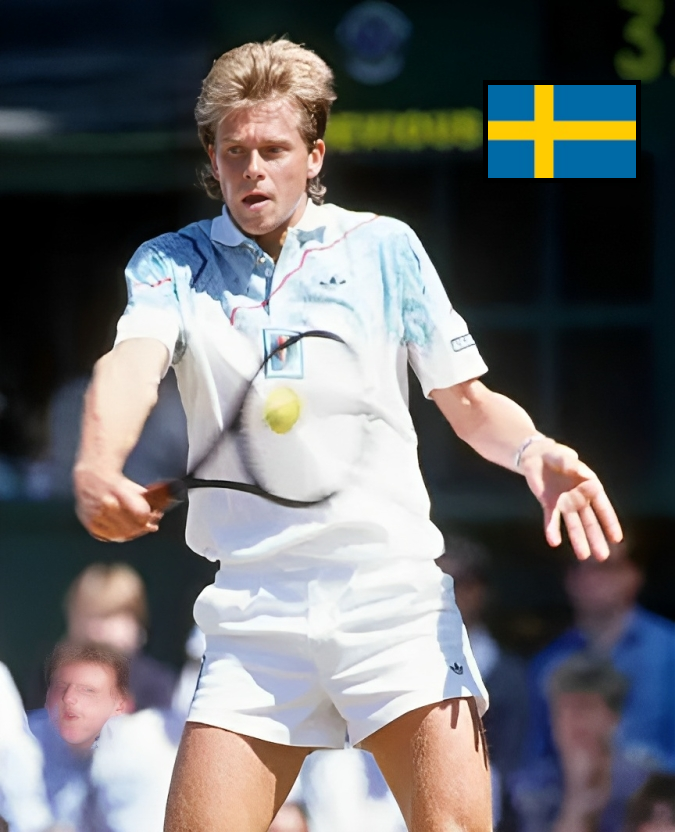
Stefan Edberg
Born: January 19, 1966 in Västervik (Kalmar)
Height: 1.88 m
Plays: Right-handed
Sweden dominated world tennis for two decades, during the 1980s and ’90s. The ’80s stood out significantly, while the ’90s were notable compared to the subsequent decline in the 21st century. In the ’80s, the strength of Swedish tennis was embodied by a roster including Björn Borg (who regularly played only in 1980-81 given that decade), Mats Wilander, Henrik Sundström, Anders Järryd, Joakim Nyström, Jonas Svensson, and Kent Carlsson. The ’90s showcased players like Thomas Enqvist, Magnus Larsson, Magnus Gustafsson, Jonas Björkman, Magnus Norman, and Thomas Johansson. Stefan Edberg bridged both generations, contributing to Davis Cup triumphs over a decade and displaying a consistent serve-and-volley style across all surfaces, a unique approach among players of his generation.
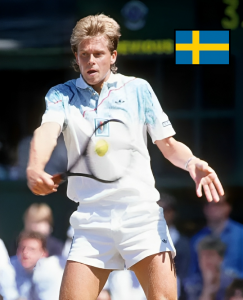 Edberg, an exceptional junior player, achieved the rare feat of capturing all four Grand Slam junior titles in 1983, earning the lone “Junior Grand Slam” in the Open Era. However, his professional career nearly ended already at its beginning, during the US Open ’83, when his serve tragically caused the death of linesman Dick Wertheim. The incident plunged Edberg into depression, contemplating quitting tennis. Fortunately, he eventually realized it was a tragic accident and found the strength to continue.
His breakthrough came in ’84 during his first full year on the tour, securing success in doubles by aiding Sweden’s victory over the USA in the Davis Cup final alongside Järryd. In the mid-’80s, Edberg emerged as a formidable force in both singles and doubles, dethroning John McEnroe as the premier singles and doubles player and as the best serve-and-volleyer. Despite securing two Australian Open titles on grass (1985 and 1987, yet back-to-back), he recognized the need to enhance his game to challenge Ivan Lendl, identifying his forehand as a significant hurdle (his one-handed backhand belongs to the best of his era). Playing all the strokes with a classical continental grip was unique for the time (a norm for operating wooden racquets), limiting his ability to generate fast topspin balls off the forehand.
Under the guidance of his British coach Tony Pickard (a decent player in the 1950s and ’60s), Edberg evolved his game, tweaking his service motion as well as the grip (adoption of eastern backhand) in the late ’80s to maintain a high percentage of first serves (often around 65%) and produce kick-serves that posed considerable discomfort, especially for opponents with one-handed backhands, a prevalent style among players at that time. He naturally gravitated toward the net, fine-tuning his footwork to achieve optimal positioning and overcoming initial troubles with foot faults. As a receiver, Edberg acknowledged his forehand limitations, using it primarily to keep the ball in play while excelling in passing shots off the weaker wing with strategic angles.
Despite struggles against players with greater top-spin and athleticism, especially Jim Courier (Edberg lost to him four four-setters at Slams in the years 1991-93, even at Wimbledon), Edberg’s physical peak from ’89 to ’92 showcased remarkable tennis prowess (uniquely emphasised at the US Open ’92 when he overcame three elite players in consecutive five-setters being on the verge of defeat in fifth sets thrice), capitalizing on his exceptional movement and often employing a ‘cheap-and-charge’ strategy. He even came close to triumphing at Roland Garros, notably reaching the final in ’89 but squandering many opportunities against Michael Chang to win 3-1. Interestingly, he later reversed this outcome in ’96, displaying a different level of reflexes against a vastly improved Chang in his prime.
The late ’80s saw Edberg engaged in intense rivalries with Lendl, Wilander, and most prominently, Boris Becker. Despite Becker’s overall 25-10 advantage in their matches, Edberg prevailed in critical “best of five” encounters, leading 2-1 in Wimbledon finals, 1-0 in ‘Masters’ finals, and 1-0 at Roland Garros.
Edberg’s decline was swift, notably in ’94. Despite being 28, not considered a veteran by standards then, after reaching the Australian Open semifinal, his performance took a nosedive. Between Roland Garros ’94 (one of the tightest clay-court matches of all-times) and Wimbledon ’96, Edberg failed to progress beyond the fourth rounds at majors, a significant downturn for a player accustomed to quarterfinal appearances at least. He was interested in claiming Grand Slam titles, but realizing it wouldn’t be possible, he made the decision to retire despite maintaining a Top 20 ranking.
From a tactical perspective, I believe that Edberg’s serve remains an underrated aspect of his game. In the late 80s, he adjusted his preparation and technique for the serve, reducing the speed while enhancing accuracy and the percentage of successful first serves. He consistently varied the direction of both his first and second serves, keeping opponents guessing and often earning free points directly or as a result of his subsequent volleys. It’s noteworthy his economic approach on serve, constant attacks to the net behind the second serves were a norm, yet often at 40/0 or 40/15 he was staying back behind the first serve. An essential aspect of his serve was its adaptability in changing pace. Initially hailed as a powerful server in his teenage years, he transitioned in his 20s, prioritizing precision over sheer velocity. Nevertheless, he reserved those big serves for critical moments, often deploying them in the closing stages of matches or during tie-breaks.
Career record: 801–270 [ 285 events ]
Career titles: 41
Highest ranking: No. 1
Best GS results:
Australian Open (champion 1985 & 87; runner-up 1990, 92-93; semifinal 1988, 91 & 94)
Roland Garros (runner-up 1989; quarterfinal 1985, 91 & 93)
Wimbledon (champion 1988 & 90; runner-up 1989; semifinal 1987, 91 & 93; quarterfinal 92)
US Open (champion 1991-92; semifinal 1986-87; quarterfinal 1996)
Masters champion 1989
Davis Cup champion 1984 (doubles), 1985 & 1994
World Team Cup champion 1988, 91 & 95
Gold medal of unofficial event at Olympics 1984 (Los Angeles) & Bronze in Seoul ’88
Year-end ranking 1982-96… 523 – 53 – 20 – 5 – 5 – 2 – 5 – 3 – 1 – 1 – 2 – 5 – 7 – 23 – 14
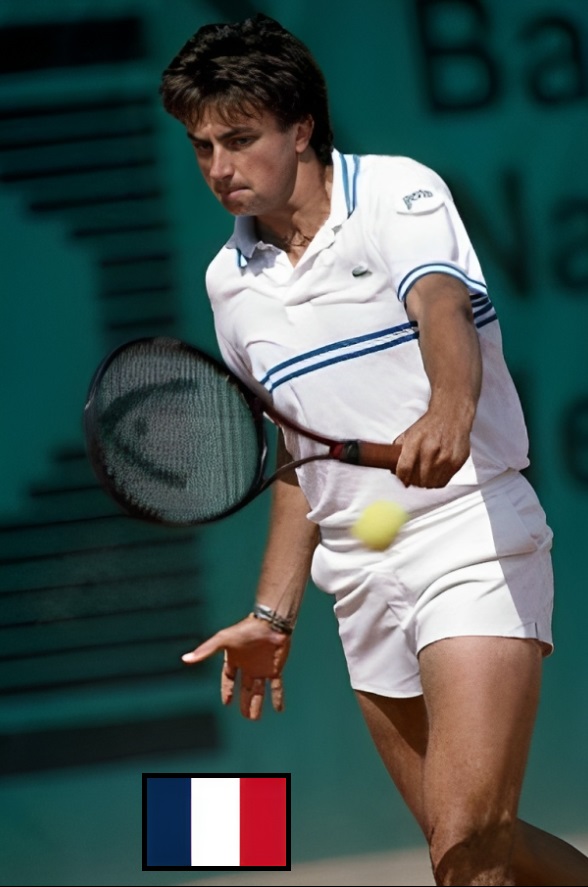
Henri Leconte
Born: July 4, 1963 in Lillers (Hauts-de-France)
Height: 1.84 m
Plays: Left-handed
In retrospect, when considering five distinct generations of French players during the Open Era, it seems that the cohort playing in the 1980s boasted the best talents. Yannick Noah (born in 1960), along with two younger left-handed players, Henri Leconte (b. 1963) and Guy Forget (b. 1965), stood out. Noah remains the sole French player to have clinched a major title, while Leconte played in a major final. However, Forget’s performances at majors overall were disappointing, even though he managed to secure two ‘Mercedes Super 9’ titles in 1991 and contributed significantly to France’s Davis Cup victory that same year, alongside Leconte.
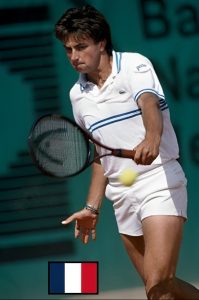 Leconte’s impact on the tennis scene emerged in November ’82 when he claimed his first title in Stockholm, defeating the then French Open champion, Mats Wilander, in the final (notably, Leconte saved three match points in the third round against Tomáš Šmíd). His triumph in Stockholm also earned him a spot in the Davis Cup final, yet he lost a crucial rubber to Gene Mayer. The following year Leconte defeated the best player of the 70s Björn Borg (Monte Carlo), twice the best player of the 80s Ivan Lendl (the Czechoslovak hadn’t that status yet, but his potential dominance in the decade was rather conspicuous then, Leconte even had a 5:3 lead in H2H against Lendl at some point in 1985), thus expectations that Leconte would be a leading player in the 80s were obvious. The years 1986-88 marked the zenith of Leconte’s career, with seven out of his sixteen finals occurring during this period. His performance in major tournaments culminated in the French Open ’88 final. Having won three five-setters prior to the final, Leconte succumbed to fatigue after losing the opening set to the formidable Wilander.
Unfortunately, on May 12, 1989, Leconte underwent the first of three operations for a herniated disk, marking a turning point in his career. The year 1991, at the age of 28, heralded a downturn that eventually led to his retirement five years later. Nevertheless, the end of that year held a sweet moment. Noah, now Davis Cup captain in the twilight of his career, enlisted Leconte to play the second rubber in a tie against the United States. Despite being ranked at No. 159 and having not won a match for five months, Leconte stunned Pete Sampras. The following day, he assisted Forget in defeating one of the top doubles pairs at that time, Ken Flach and Robert Seguso, in a manner that exceeded expectations.
Struggling with his herniated disk, Leconte continued to surprise. First, at the French Open ’92, he advanced to the semifinals as a ‘wild card’ [200]. Then, in Halle ’93, he secured his final title as a player ranked at No. 141, overcoming two Top 10 players in the last two matches. Prior to the event, Leconte held a dismal 2-8 record for the year. He concluded his career at his beloved French Open, in the year 1996. Sixteen years after making his first main-level appearance at the tournament, he fell to a Swedish player again (Hans Simonsson in 1980 and Thomas Johansson in 1996).
Leconte departed the Centre Court in tears with flowers, marking the end of an era. Suddenly, he reappeared as a ‘wild card’ two weeks later in Rosmalen, only to lose to Kenneth Carlsen. This match ultimately stood as his final appearance at the main-level of his professional career (though he did play two more Challengers that year). Leconte’s service motion was short, similar to Roscoe Tanner‘s serve – the best in the 70s. He was an all-round player, adept at implementing a serve-and-volley style across all surfaces (only a few players in the 80s could be as effective attacking the net behind the second serve). His exceptionally quick hands, especially on his backhand, were at times sensational, producing astonishingly fast strokes with a short swing. An emotional player, Leconte thrived on interacting with the crowd, drawing inspiration from the loud atmosphere. Chanting “Henri! Henri!” was something he relished while playing in France; it seemed to elevate his game to another level.
One notable example of this came during the fourth round of the French Open ’90 facing Andrey Chesnokov, who was then displaying some of the best tennis of his career after winning Monte Carlo and finishing as the runner-up in Rome. Chesnokov had won 16 of his last 17 matches and was considered a favorite for the title. However, Leconte almost outplayed him in straight sets in under two hours on Centre Court. Despite Chesnokov seizing control in sets three and four, Leconte responded with an ‘all or nothing’ attitude in the decider. He relentlessly attacked the net as both a server and receiver, winning the deciding set 6-3. Out of the 29 points he earned, an impressive 16 came from his winners (55% while a clay-court norm is above 20%)! Leconte took part in the first final I have seen in my life – Antwerp ’90 – the only event in which he faced Brad Gilbert despite spending the entire 80s on the tour together. The gifted Frenchman defeated all the best players of the 80s, except fellow left-handers, Jimmy Connors and John McEnroe, and only once Leconte was awfully close to leave the court as a winner in 16 meetings against them (Australian Open ’85).
Trivia: the Frenchman was the first man in the Open Era to face a player in every major (it was Amos Mansdorf, they met in the four most important cities tennis-wise in the years 1985-87… Leconte won everywhere, needing a decider only in London).
Career record: 377–269 [ 250 events ]
Career titles: 9
Highest ranking: No. 5
Best GS results:
Roland Garros (runner-up 1988; semifinal ’86 & 92; quarterfinal ’85 & 90)
Wimbledon (semifinal 1986; quarterfinal 1985 & 87)
US Open (quarterfinal 1986)
Davis Cup champion 1991
World Team Cup champion 1986
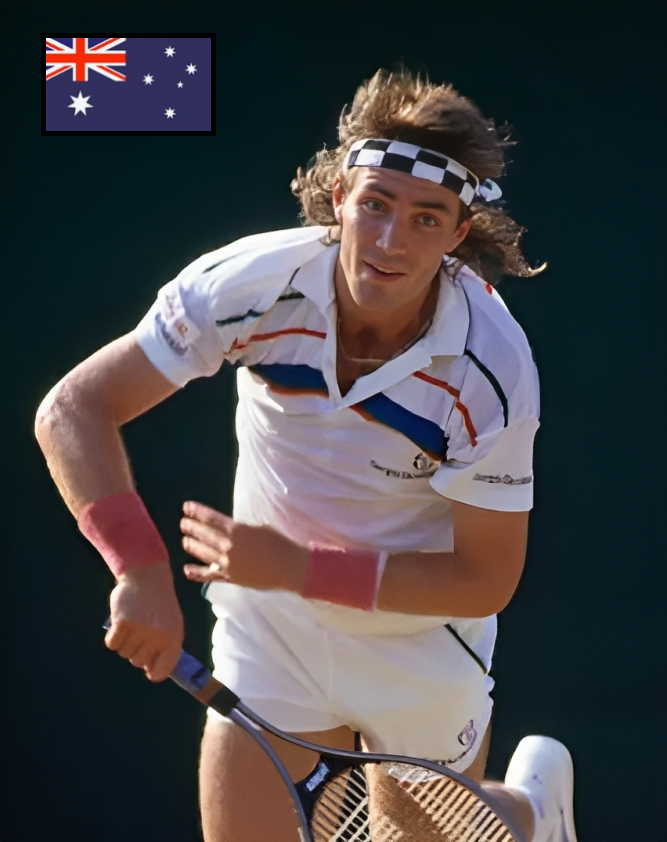
Pat Cash
Born: May 27, 1965 in Melbourne (Victoria)
Height: 1.83 m
Plays: Right-handed
Considered one of the most accomplished players without reaching the 300 main-level wins milestone, Cash’s sudden decline in the ’90s potentially deprived tennis of numerous thrilling matches. He belonged to the same generation as Stefan Edberg and Boris Becker, emerging as an elite serve-and-volleyer in the mid-’80s before turning 20 (the US Open ’84 semifinal was his most captivating result as a teenager… he was using a wooden/graphite composite manufactured by Puma). While lacking Becker’s serve and forehand or Edberg’s 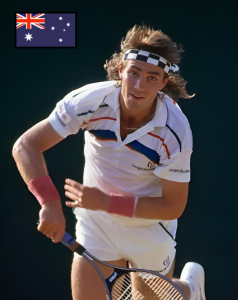 backhand, Cash compensated with a warrior-like mentality, an acute game sense, and his early career successes were comparable to these achieved by the multiple Grand Slam champions.
By the age of 23 in 1988, Cash had contested three major finals (equalling Edberg and Becker) and steered Australia to two Davis Cup victories (1983 and 1986), contributing significantly to both triumphs by securing crucial points and clinching decisive matches. Cash’s commendable head-to-head records against Ivan Lendl (3-3 at majors, including Wimbledon ’87 final – the last Grand Slam title won using an aluminium racquet, Prince “Magnesium Pro”) and Mats Wilander (5-4 record overall) suggest he could have been a formidable contender not only against Pete Sampras but also against Michael Chang, Andre Agassi, and Jim Courier in competitive Grand Slam encounters of the 90s. However, his prowess wasn’t as pronounced on clay courts due to relatively weaker groundstrokes. Technically, his mastery of the lob surpassed that of Edberg and Becker, proving instrumental on faster surfaces but inconsequential on clay.
The Wimbledon ’88 tournament, culminating in an unexpectedly short defeat to Becker, marked the conclusion of Cash’s peak years on the tour (he already switched to a graphite racquet, Yonnex “Rex-50”). Over the subsequent nine years, he grappled mainly with injuries (knee and Achilles tendon) and made sporadic attempts at resurrecting his career. His involvement in several seasons (1989, 1994-97) was limited to just a few tournaments, in 1993 he didn’t play at all (he’d experienced an extended period on the sidelines for the first time in the years 1985-86 when a back injury caused his fall from no. 7 to no. 413 between Wimbledons). Throughout this turbulent period, he clinched a solitary impressive win in Dubai ’95, stunning Thomas Muster, who was at the peak of his form, in a hard-fought match (2-6, 6-4, 6-4) being two games away from defeat in consecutive sets. “My goal is not to be a Top 20 player again, I believe in my game and have to show those guys I’m serious and came back” – said the 526th player in the ranking. In his another event he reached the Copenhagen quarterfinal surviving two dramatic matches, and it was basically over of his serious comeback. For another two years he would win only two matches losing fourteen.
Post-retirement, Cash transitioned to coaching top players like Mark Philippoussis and Greg Rusedski while also participating regularly in the Champions Tour, albeit without securing a title in any of those events. His trademark: black and white chequered headband (he wore it from 1987 to the end of his career ten years later).
Career record: 243–148 [ 139 events ]
Career titles: 6
Highest ranking: No. 4
Best GS results:
Australian Open (runner-up 1987-88; quarterfinal 1982 & 84)
Wimbledon (champion 1987; semifinal 1984; quarterfinal 1986 & 88)
US Open (semifinal 1984)
Davis Cup champion 1983 & 86
Goran Ivanišević
Born: September 13, 1971 in Split (Dalmacija in Yugoslavia)
Height: 1.93 m
Plays: Left-handed (two-handed backhand)
Ivanišević stands as one of the most psychologically intriguing players of the ’90s. He was a constant chameleon, altering his appearance regularly: long hair, short hair (at the start of 1992, he sported an almost bald “mohawk” hairstyle), with stubble, a full beard, or clean-shaven. He’d don a cap or a headband, and in 1996, a flamboyant plume above his forehead emerged. “I think young people like it. Old people, you know, are not so happy. It’s tough to please old people. They complain too much,” he quipped about his eccentric hairstyle.
Consistency wasn’t his forte; Ivanišević rarely wore the same T-shirt for longer than a month, though he favored the “Sergio Tacchini” brand, and stuck his entire career to “Head” racquets with yellow over-grips. His constant sartorial changes painted a picture of emotional inconsistency. On-court jests and amicable interactions with people could abruptly transform into eruptions of anger. Throughout the ’90s, he found himself embroiled in dramatic matches more frequently than any other player.
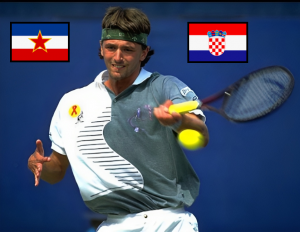 In matches involving Ivanišević, anything seemed possible: a 15-13 victory in the fifth set against Richard Krajicek, or a heart-wrenching 12-14 loss in the fifth set against Magnus Norman. He twice equalled the record for the longest tie-break (20/18) within four years, triumphing against fellow left-handers Daniel Nestor and Greg Rusedski. He clinched other marathon tie-breaks: 15/13 (Guy Forget), 14/12 (Jason Stoltenberg, Sébastien Lareau), or 13/11 (Fernando Luna, Hendrik Dreekmann, Cyril Saulnier) while other experienced players rarely go above 10-all. Astonishingly, he found ways to lose tie-breaks despite leading 5:0 or 5:1.
In 1998, he found himself embroiled in major three-setters consisting of three tie-breaks, losing to Marzio Martelli, then defeating Jan Siemerink in a unique Open Era match where the winner saved set points in all won sets. His matches resembled a roller-coaster ride, swinging between extremes. His phenomenal serve, arguably the best of the ’90s, was his cornerstone. Often leading to victories, it was occasionally a double-edged sword. Upon analysing his serve, I arrived at, perhaps, controversial conclusions. I often sensed that, even against top players, he deliberately provoked difficult situations to test his mentality under pressure.
I witnessed numerous matches where, at 4:5 or 5:6 in a set or in a tie-break, he gifted the opponent an opportunity only to erase it with an ace/service winner, even off the second serve. He relished the thrill of winning sets on the brink of losing them. While his serve rescued him many times, it also caused bitter defeats, deserting him in crucial moments of significant matches. Three Wimbledon finals saw his serve betray him, once (1992) against Andre Agassi as a favorite, and twice (1994 and 1998) against his toughest rival, Pete Sampras. It also faltered thrice in “Masters” semifinals (1992, 1993 and 1996).
A notable example was his encounter with Sampras in Hannover ’96. Ivanišević served phenomenally that day, notching 35 aces in three sets. As the deciding third set tie-break loomed, he led 30/0 in the 12th game. However, three casual errors gifted Sampras a match point. Ivanišević unleashed a 186 kph second serve, the fastest that day, but it sailed out. Sampras, disbelievingly observing the speed measurement, shook his head in disbelief. Despite being only a month younger than Sampras, Ivanišević was initially ranked higher in their first two years on the tour, already reaching the Australian Open ’89 quarterfinal when Sampras was actually unknown. Their encounter in the München quarterfinal in 1990 (Grand Slam Cup), where Sampras barely clinched victory, laid the groundwork for a mental edge for the American.
Though Ivanišević navigated tight situations adeptly in general, against Sampras, a few points here and there often separated him from clinching crucial victories. However, by the end of 1995, Ivanišević revamped his coaching staff and began winning matches consistently. Between December ’95 and March ’96, he competed with astonishing frequency, securing five titles in the process. He finally ousted Sampras in the Key Biscayne semifinal. Just when it seemed he would dethrone the American, fatigue took its toll, forcing his retirement in the final. Nevertheless, it marked the pinnacle of his career, his most prolific year.
The late ’90s brought stagnation, leaving many expecting Ivanišević to be remembered as the best player of his generation without a major title. And then came Wimbledon ’01 – an event of miracles. Ivanišević [125], a mere ‘wild card’ entrant, caused a stir by defeating Carlos Moyá in the second round. The seven-time champion, Sampras, fell in the fourth round to a young Roger Federer, paving the way for the Croat. Mirroring his mid-’90s form, he served exceptionally and luck favored him (winning back-to-back matches being two points away from defeat). At 30, reminiscent of Andrés Gómez and Petr Korda, Ivanišević triumphantly raised the most coveted trophy in tennis.
“I don’t care now if I ever win a match in my life again,” Ivanišević said after the memorable Monday final against Patrick Rafter (his semifinal against Tim Henman extended over three rain-hit days!). “Whatever I do in my life, wherever I go, I’m always going to be Wimbledon champion.” He didn’t achieve anything worth remembering afterward, Wimbledon ’01 marked Ivanišević’s glorious swan song. He’s the only player to achieve noteworthy results representing two countries: in 1990-1991 he played the World Team Cup finals for Yugoslavia, third final (1995) in this competition he notched representing Croatia, and for this country – carrying the flag at the opening ceremony in Barcelona – he won the Olympic bronze medal, winning four successive five-setters (before and after him, no-one has done it in the Open Era), two of them withstanding match points in the fifth sets. After retiring, he regularly participated in the Champions Tour and then began coaching players born in Yugoslavia: Croatian Marin Čilić and Serbian Novak Đoković, helping them in winning Grand Slam events.
Career record: 599–333 [ 337 events ]
Career titles: 22
Highest ranking: No. 2
Best GS results:
Australian Open (quarterfinal 1989, 94 & 97)
Roland Garros (quarterfinal 1990, 92 & 94)
Wimbledon (champion 2001; runner-up 1992, 94 & 98; semifinal 1990 & 95)
US Open (semifinal 1996)
Grand Slam Cup 1995 champion
Olympic bronze medallist 1992 in Barcelona
World Team Cup 1990 champion (for Yugoslavia)
Davis Cup champion 2005 (he was only a member of the Croatian team in the final)
Hopman Cup 1996 champion (for Croatia)
1993 and 2023
January: Week 1 – Week 2 – Week 3/4 (AUSSIE OPEN)
February: Week 5 – Week 6 – Week 7 – Week 8
March: Week 9 – Week 10/11 (Indian Wells) – Week 12/13 (Miami)
April: Week 14 – Week 15 (Monte Carlo) – Week 16
May: Week 17/18 (Madrid) – Week 19/20 (Rome) – Week 21
June: Week 22/23 (FRENCH OPEN) – Week 24 – Week 25 – Week 26
July: Week 27/28 (WIMBLEDON) – Week 29 – Week 30
August: Week 31 – Week 32 (Toronto) – Week 33 (Cincinnati) – Week 34
September: Week 35/36 (US OPEN) – Week 37 – Week 38 – Week 39
October: Week 40/41 (Shanghai) – Week 42 – Week 43
November: Week 44 (Paris) – Week 45 – Week 46 (“Masters”) – Week 47 (Davis Cup)
December: Week 48 (“Young Masters”) – Summary
Rivalry at the Top
In 1993, the entire season was captivated by the rivalry between two US players: Pete Sampras and Jim Courier. One year older Courier continued his astounding form on clay and hardcourts, which had begun at Indian Wells ’91, while Sampras finally lived up to the expectations set by his US Open ’90 title. However, the latter part of the season saw an abrupt end to this rivalry. Courier lost his form, and concurrently, Michael Stich, who had been relatively successful earlier in the season, surged, dominating the autumn of ’93. Looking back, Stich may be regarded as the most successful player in the final quarter of the season, clinching three indoor titles, two of which were highly prestigious (especially Frankfurt), and leading Germany to victories over Sweden and Australia in the Davis Cup, triumphing over almost all the top-ranked players of that time.
Thirty years later, the first half of the season was marked by a rivalry among three players: Novak Đoković, Carlos Alcaraz, and Daniil Medvedev. Jannik Sinner joined in the latter part of the season, initially in a more cautious mode as his Wimbledon semifinal and victory in Toronto were partially due to very favorable draws. In the autumn, he ascended to a higher level, defeating all three higher-ranked players multiple times, including Medvedev thrice and Đoković twice.
The Fall
Guy Forget, one of the leading players of the early ’90s, suffered a severe injury at Hamburg ’93, sidelining him for nearly a year and causing a significant drop in rankings from no. 17 to 623. That year was critical for Ivan Lendl, the most dominant player of the ’80s, as it was the first time since his teenage years that he was unable to be competitive in the “best of five” format. He also lost his edge in crucial moments of tighter sets, a trend that continued in 1994, leading to his retirement at the age of 34. Andre Agassi, a Top 10 player from 1988 to 1992, experienced the first of his two major crises in his long career (the second would occur in 1997), resulting in a plummet to no. 24 by the end of the season.
Three decades later, more elite players had a disastrous season, especially Rafael Nadal, one of the greatest players of all time, who participated in only two events at the beginning of the year and dropped from no. 2 to 670 (two places below him is Marin Čilić, the former US Open champion, who also played just two events this year, beginning it as no. 17). Nadal’s compatriot Pablo Carreño Busta falls down from no. 13 to 606 having played three ATP events (two Challengers). Nine years younger than Nadal, Nick Kyrgios played just one event, resulting in his disappearance from the ATP ranking after being ranked no. 22. Matteo Berrettini, another significant name in the past few years, faced physical problems throughout the ’23 year, plummeting from no. 14 to 92. The 27-year-old Berrettini began and ended the year positively, first aiding Italy in reaching the final of the United Cup, and then concluding the year on the bench, motivating his younger Italian compatriots during the Davis Cup triumph.
The Rise
Nineteen-year-old Andrei Medvedev was a rising star in 1993. The Ukrainian, with a somewhat wooden yet efficient style, proved to be successful on all surfaces. Many pundits viewed him as a potential main rival for Pete Sampras in the second half of the ’90s. However, Medvedev’s peak was actually reached the following year, before he turned 20. Although four of Medvedev’s peers finished their careers with more accomplishments, in 1993, none of them was frequently mentioned in the same breath as Medvedev. Here’s a ranking comparison of the best players born in 1974 at the end of 1993:
6 – Andrei Medvedev
76 – Àlex Corretja
88 – Thomas Enqvist
102 – Yevgeny Kafelnikov
372 – Tim Henman (before his ATP debut)
Two prodigies born in 2003, Carlos Alcaraz and Holger Rune, confirmed their tremendous potential displayed a year before. As I write this, it seems they along with two years older Jannik Sinner – could create a new “Big 3” in the ’20s. However, it’s a shallow assumption that doesn’t account for super-talented players born in the mid-2000s who might emerge in a few years. The current best teenager, Arthur Fils, is ranked 36. My early estimation suggests he may have a more successful career than a fellow Frenchman, Gaël Monfils.
Veterans
The age of veterans shifted from the age of 30 to 35 over thirty years. In 1993, there were few players who could turn 30 and still pose a threat. One of them was Ivan Lendl, mentioned earlier, but at 33, he reached his physical limits. Other famous players in their thirties who were approaching the twilight of their careers included Brad Gilbert (32), Anders Järryd (32), as well as Mikael Pernfors and Henri Leconte, both at 30. The former French Open champion Andrés Gómez decided to retire at 33 in 1993 while four years older Björn Borg, the icon of the 70s, finally played the last match in his professional career, ultimately completing his retirement which had been initiated… ten years earlier. Thirty years later the most significant name to finish career is John Isner (38), a man who brought serving and playing tie-breaks to another level.
In 2023, Novak Đoković defied the age paradigm by securing three major titles and enjoying one of the best seasons of his illustrious career at the age of 36. Other players from his generation still achieved notable results: Andy Murray, only seven days older than Đoković, reached the final in Doha; 37-year-old Gaël Monfils triumphed in Stockholm; his contemporary Richard Gasquet commenced the season with a title in Auckland, and 38-year-old Stan Wawrinka was a runner-up in Umag. Feliciano López, aged 42, reached the quarterfinals in his farewell event this year (Mallorca). Thirty years ago the oldest player to win an ATP match was Jimmy Connors (41). Below is the ranking of players aged 35 and above in the Top 100:
1 – Novak Đoković
42 – Andy Murray
49 – Stan Wawrinka
74 – Gaël Monfils
76 – Richard Gasquet
Game-styles
In 1993, the trend initiated in the late ’80s/early ’90s continued, transitioning from aluminium racquets to graphite ones (Cédric Pioline was a significant exception), which led to increased serve-and-volleyers garnering points directly behind their serves, primarily focusing on tie-breaks. Notably, Pete Sampras, Michael Stich, Goran Ivanišević, and Richard Krajicek epitomized this style, contrasting with players like John McEnroe (finished his career at the end of 1992, but took part in two exhibition events of ’93), Stefan Edberg or Pat Cash (due to injury he missed the entire ’93 season), who were faithful to the chip-and-charge strategy as returners. Boris Becker stood somewhat in between; in the mid-’80s, he was a prototype for players who emerged in the early ’90s. Canadian Greg Rusedski entered the scene in 1993, known later for breaking his own records in serve-speed as well as being super dependent on tie-breaks. At that time, the magical velocity touched 200 kph (125 mph) – rarely crossed by servers. Other young player, who gathered some attention in 1993 it was Australian Patrick Rafter, a follower of the McEnroe/Edberg tradition. These two “R” native English speakers would face each other in an unexpected US Open ’97 final, and Rafter’s finesse triumphed over a show of brute force in a duel of two different S/V mindsets. Rusedski finished the year 1993 ranked 50th, Rafter 16 places below. More than four years later they’ll enter an event trying to become world’s no. 1 (Key Biscayne ’98).
At the end of 1993 in the Top 20, there were eight serve-and-volleyers, nine offensive baseliners, and three defensive baseliners (noting that Michael Chang was improving his serve, transforming into an offensive baseliner in the mid-’90s). The landscape is somewhat simplistic as players often adjusted their styles based on the surface (carpet was still popular, encouraging players to more offensive attitude indoors). The ratio of one-handed and double-handed players inside the Top 20 was pretty balanced.
In contrast, today, only two players among the Top 20 use one-handed backhands (Stefanos Tsitsipas & Grigor Dimitrov), and there’s a single style prevailing across players – offensive baselining – regardless of the surface. Among the current top twenty, only Alex de Minaur and Cameron Norrie adopt a more defensive approach during baseline exchanges. Termed “defensive baseliners,” their gameplay differs significantly from the excellent clay-courters of the mid-’90s, such as Sergi Bruguera and Thomas Muster, who operated deeper behind the baseline, with higher net clearance.
Statistical summary of these two seasons here
Posted in Tournaments
Leave a comment