
My eBook

Categories
-
Recent Posts
September 2026 M T W T F S S 1 2 3 4 5 6 7 8 9 10 11 12 13 14 15 16 17 18 19 20 21 22 23 24 25 26 27 28 29 30
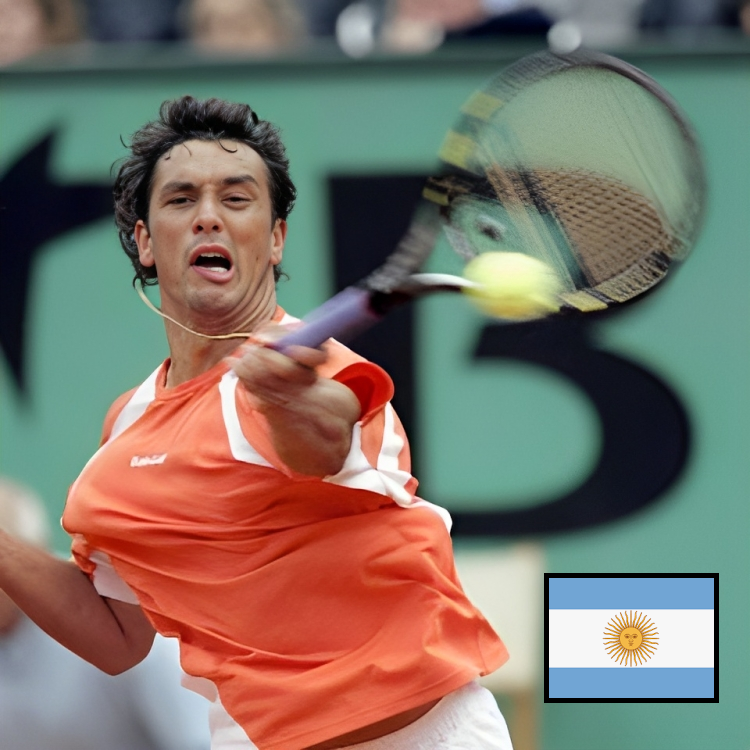
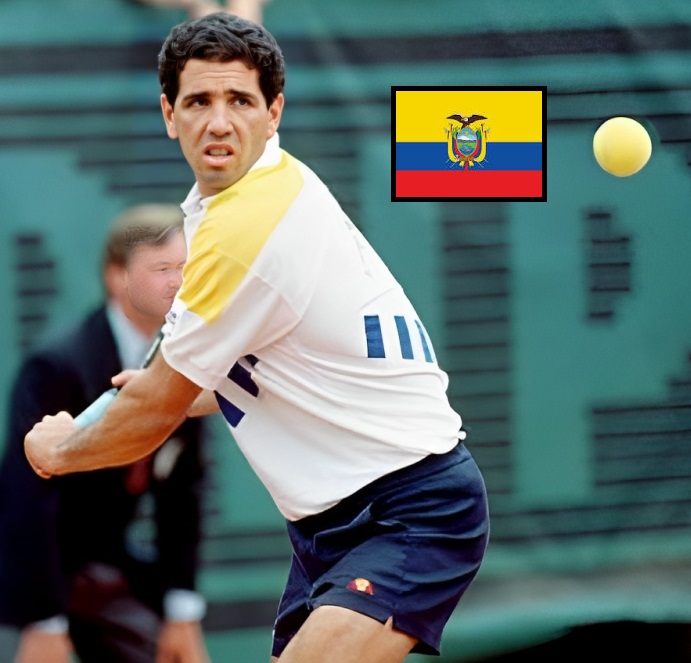
Mariano Puerta
Born: September 19, 1978 in Córdoba (Sierras Pampeanas)
Part of an intriguing generation of South American players emerging on the tennis circuit in the late ’90s, the infamous Argentinian wasn’t as naturally gifted as his counterparts like Chilean Marcelo Ríos, Brazilian Gustavo Kuerten, or Ecuadorian Nicolas Lapentti. Nevertheless, Puerta solidified his status as a regular ATP player after Wimbledon ’98 and was seen as a potential future top Argentinian player among the likes of Mariano Zabaleta (he had a similar service technique to Puerta, elevating his racquet before the ball toss), Franco Squillari, and Guillermo Cañas.
Career record: 128–118 [ 117 events ]
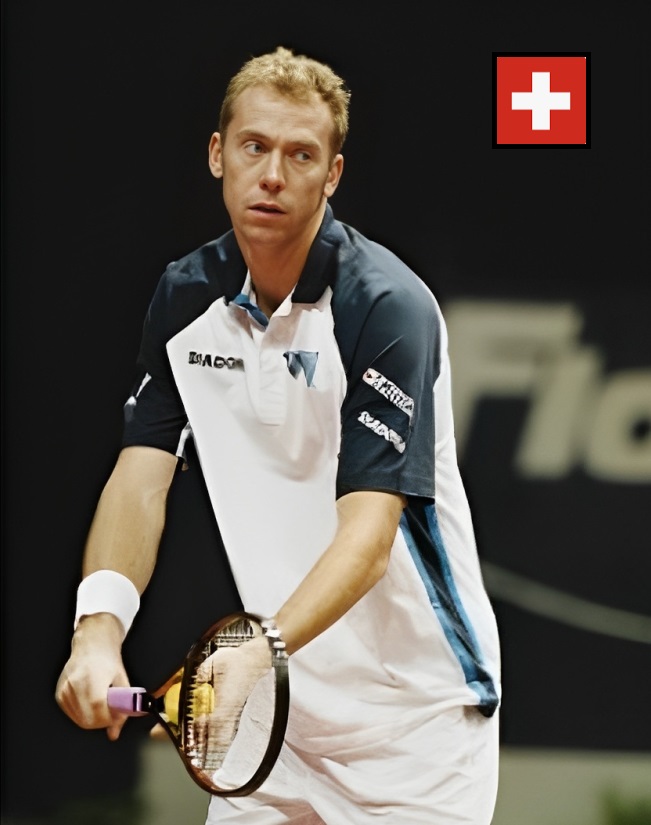
Marc Rosset
Born: November 7, 1970 in Genève (Romandie)
Height: 2.01 m
Plays: Right-handed (two-handed backhand)
Rosset, much like David Wheaton, is considered a notable underachiever in the tennis landscape of the 90s (nonetheless Rosset’s career was much longer and incomparably better). His potential warranted an entry into the strict elite circle, possibly even partaking in several “Masters” events or clinching a major championship. Wheaton’s trajectory took a downturn after he captured a title in München ’91 (Grand Slam Cup) – an event that appeared to dampen his motivation for years to follow. On the other hand, Rosset experienced the zenith of his career a few months later, securing his most significant success at the Olympics.
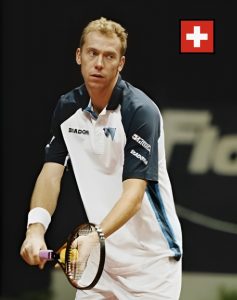 From 1990 onward, Rosset was touted as one of the most promising young talents. However, his performances, especially at the majors, proved disappointing, leading many to doubt his capability in the “best of five” format. Yet, remarkably, the seemingly lackadaisical Swiss surprised everyone in Barcelona ’92, storming into the medal zone, notably defeating Jim Courier in the third round. It was a stunning 6-4, 6-2, 6-1 victory, raising eyebrows, particularly considering Courier’s recent wins at Rome and the French Open that year.
Asked about Courier’s apparent decline during the match, Rosset acknowledged: “Yeah, I think so. The first set was pretty close, then I won the second. When I broke him to go up 4:0 in the third, he didn’t try hard anymore. He was just trying to get the points over with.” Despite Courier’s mental struggle in the summer of ’92, Rosset’s confidence soared. He went on to win three more matches against formidable opponents, eventually claiming the most coveted Olympic medal.
It was an incredible, patriotic year for Rosset. He clinched his sole major doubles title (French Open) with fellow Swiss player Jakob Hlasek. Together, they propelled Switzerland to their maiden Davis Cup final, where Rosset clinched a dramatic five-set victory over Courier once more. Contrastingly, the conclusion of the 1991 season hadn’t been as fruitful. Rosset hadn’t reached a single ATP final that year, despite having secured two titles as a teenager. Towards the year-end, he suffered swift defeats indoors against average players, despite possessing one of the fastest serves.
Watching Rosset during the ’90s often gave the impression that he viewed tennis as mere entertainment. He interacted with the crowd, relishing applause for his football skills. His primary shots – the serve and forehand – ranked loosely within the top ten of the ’90s. They were the most efficient indoors where he claimed his second biggest title behind the Olympics (Antwerp ’97). Even when seemingly not putting in maximal effort, these shots helped secure numerous victories on all surfaces. However, his serve was occasionally problematic. Much like Goran Ivanišević, Rosset’s nonchalance often led him to take substantial risks with his second serve. A notable example was during Stuttgart-indoors ’93. Leading 5:4 (40/15) in the third set against Michael Stich, Rosset committed two consecutive double faults while striving for an ace, resulting in a 6-7, 6-3, 5-7 loss. Two years later, Rosset found redemption, upsetting Stich 3-6, 7-6, 7-6 in the Halle final. In a riveting encounter, he saved three match points in the tie-break during the second set. In the third set, he escaped from *4:5 (15/40), saving yet another match point in that game, and a seventh (last) one at *6:7 in the decisive tie-break. It was his lone grass-court event worth mentioning, he lost more matches on that surface than won which is surprising given his powerful serve and a decent volley technique. One peculiar aspect of his game was his ability to mix two-handed backhands with one-handed ones (among two-handed players only Younes el Aynaoui depended more on slice). He usually opted for an offensive one-handed backhand when attempting passing shots, this versatility added an unpredictable edge to his play.
Post-1992, Rosset’s peak tennis was witnessed on two occasions, both occurring in Paris (he’s a French native speaker) – firstly at Paris-Bercy ’94, reaching the tournament’s conclusion on carpet (lost to Andre Agassi his lone Masters 1K final), and then at Roland Garros ’96 on clay, advancing to the semifinals after a very dramatic quarterfinal victory. In both events, he defeated several top-ranked players. As his career approached its twilight, Rosset primarily played in Challenger events, an uncommon choice for veterans who had previously graced the biggest tennis arenas. A notable instance was the Challenger held in Praha ’03, where Rosset emerged victorious, securing two consecutive wins with identical scorelines (7-6, 6-7, 7-6).
Trivia: the Swiss tennis player amassed the most consecutive victories of his career as a veteran in 2000, claiming back-to-back titles indoors (Marseille – the first of Roger Federer‘s 157 finals – and London). However, his streak was followed by four successive losses.
Career record: 433–351 [ 350 events ]
Career titles: 15
Highest ranking: No. 9
Best GS results:
Australian Open (quarterfinal 1999)
Roland Garros (semifinal 1996)
World Team Cup champion 1996
Olympic gold medal (Barcelona ’92)
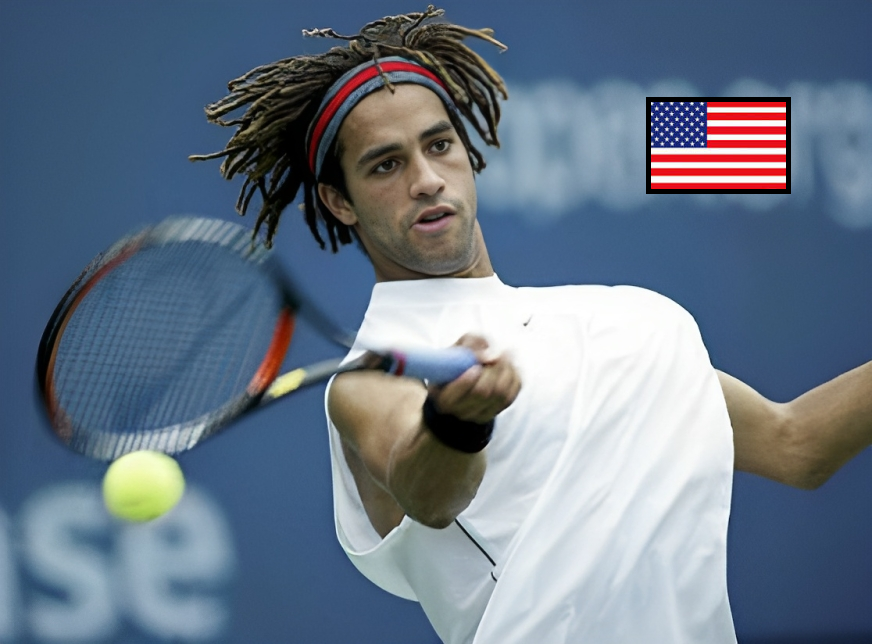
James Blake
Born: December 28, 1979 in Yonkers (New York)
Height: 1.84 m
Plays: Right-handed
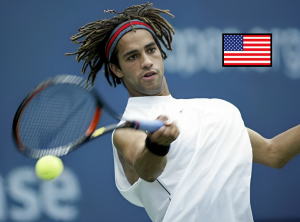 The son of an English mother, Blake, with his stylish game and distinctive dreadlocks (two years after he lost them, he began to play better), brought a refreshing aura to the tour at the start of the new century. Expectations soared high. Though not at the same level from the onset, both he and Andy Roddick were expected to fill the shoes of Andre Agassi and Pete Sampras as the mainstays of US tennis. While it did happen, the outcomes fell far below what had been anticipated for both players. The years 2001-2003 marked a turning period in Blake’s career (he didn’t finish Harvard University at the time, deciding to become a pro), establishing him as someone incredibly talented (his back-to-back five-set defeats to Lleyton Hewitt at the US Open were very telling, especially the one in 2002), possibly possessing one of the fastest forehands in history. This wasn’t just about the speed of the ball he could hit but also his super-fast reaction to the opponent’s shots.
However, mentally, he appeared unstable, often unable to hold his nerve in crucial moments required to win the most important events. At different junctures in his career, Blake held an awful record of 0-7 in deciding third-set tie-breaks at the main-level (stopped it in the Sydney ’06 final) and 0-9 in five-set matches, before eventually overcoming these challenges.
I often pondered, ‘How could someone with such a varied skill set have such dismal records?’ Here are my conclusions:
– Blake, akin to the early version of Agassi, was a front-runner… his style of play was fast-paced, but he struggled to sustain concentration for extended periods (he could keep his best focus for two hours at most)… if a ‘no-ad and champions tie-break’ system had been implemented during his era, he might have emerged as one of the most successful players;
– his backhand, although a decent shot overall, was his weakest link… in deciding sets at crucial junctures like 5-all or 6-all, he tended to miss more backhands, aware of this, he often tried to evade using his backhand excessively, taking additional risks by running around it to utilize his forehand;
– he exhibited exorbitant pride in showing emotions, especially when there was a long way to go… while he managed to win a few sets after saving match points, they were predominantly second sets, he seemingly lacked the psychological resilience to engage in a mental battle to shift the momentum, enabling him to lead 2:0 at the beginning of the deciding set after narrowly avoiding defeat in straight sets (his first ATP-level match win from a match point down came in his 138th tournament!)
– he was too conservative with his second serve… to win crucial points, he either needed to match the speed of his first serve with the second, or, given his good volley technique, occasionally experiment with a kick-serve and follow it up with a net approach
Was his talent squandered? Not entirely. His Davis Cup victory over Mikhail Youzhny in the 2007 final, on Friday, stamps his legacy, setting the tone for the weekend (the USA defeated Russia that Saturday). The subsequent year, he came within a point of securing at least a Silver medal, yet wasted a triple match point against Fernando González, a notably challenging opponent (Blake had also lost a five-setter to González in a Davis Cup encounter two years earlier). The Beijing loss must have been excruciating, especially considering Blake’s quarterfinal victory over Roger Federer, avenging eight previous defeats. As someone who became No. 4 in the world, Blake should have won at least one big title and reached a major semifinal. However, it didn’t happen; he played in three big finals (Indian Wells, Shanghai-Masters, Cincinnati), but each time, he received a lesson from Federer – also to the Swiss he lost two major quarterfinals, the third one (first chronologically) to Agassi, being two points away from the victory. In contrast to matches against Federer, Blake felt quite comfortable facing the second-best player of his era – Rafael Nadal. Blake had defeated him three times in a row, then lost four times, but each of those matched required a deciding set. Apart from Blake, also Brad Gilbert and Guy Forget reached the No. 4 in the world never advancing to a Grand Slam semifinal, however, they both triumphed in events adequate to current Masters 1K (Forget twice).
Career record: 366–256 [ 245 events ]
Career titles: 10
Highest ranking: No. 4
Best GS results:
Australian Open (quarterfinal 2008)
US Open (quarterfinal 2005-06)
Davis Cup champion 2007
Hopman Cup champion 2003-04
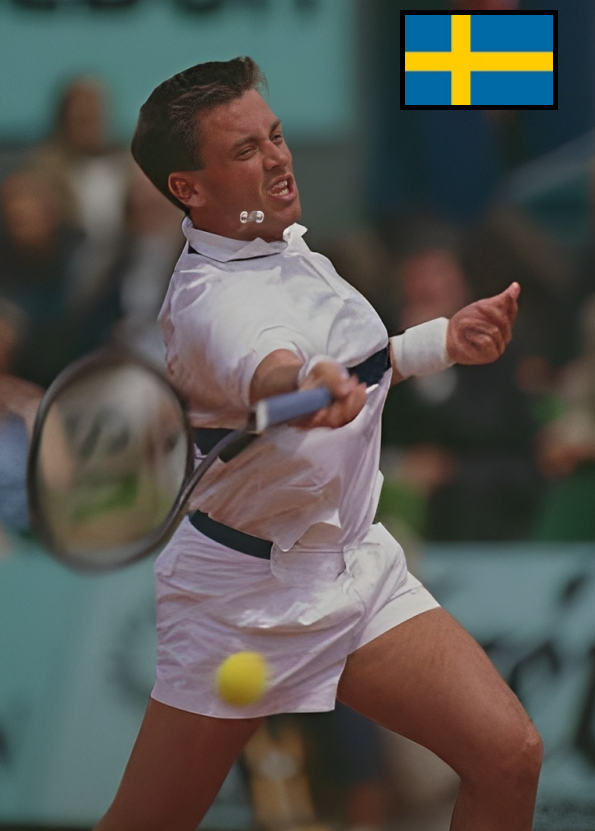
Mikael Pernfors
Born: July 16, 1963 in Malmö (Skåne)
Height: 1.73 m
Plays: Right-handed (two-handed backhand)
An outlier among the notable Swedish tennis players born in the 1960s, crafted a career distinct from his compatriots. As a member of Sweden’s golden generation of tennis, Pernfors’ path to success, veered away from the typical Swedish mold. Unlike his counterparts, he did not possess towering height and, contrary to the prevalent “Björn Borg‘s pattern” he did not conform to the archetype of the patient Swedish blonde double-handed baseliner. Despite his shorter stature, the brown-haired Pernfors, blended retrieving and attacking strategies, above all displaying a penchant for lobs – popular strokes in an era featuring more attacking players than defensive ones, thereby becoming his trademark.
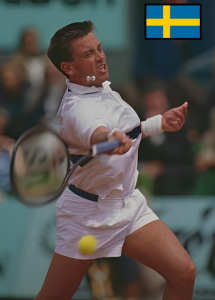 While other Swedish players trained extensively among their countrymen, Pernfors pursued education at the University of Georgia in the United States. There, he achieved a remarkable feat by becoming the first player since Dennis Ralston [1942-2020] two decades earlier, to clinch back-to-back NCAA singles titles, in 1984 and 1985. “Playing college tennis, I can go in and think, ‘I’m going to win this match,'” Pernfors said in Atlanta ’86 before a match against David Pate 3-6, 6-7(12) in which he squandered eight set points. “But tonight (against a pro), I’ll think I’m not going to win a point. Here, you know every stroke’s going to be a little better, every shot has to be that much better.” His professional journey commenced relatively late, turning pro at 22 after securing his second NCAA championship. Initially ranked outside the Top 200 and grappling with a dismal 3-8 record at the main level, Pernfors encountered a sudden surge in the ATP rankings following promising performances in the early months of 1986. However, as he arrived at the French Open ’86, expectations were modest, yet he defied the odds by progressing to the final, emerging as one of the most unexpected Grand Slam runners-up in the Open Era (similar story with Martin Verkerk seventeen years later). His astonishing feat included ousting four seeded players, especially Stefan Edberg (3-2) and Boris Becker (3-1), elevating him within a year from dreaming of a Top 100 entry to securing a spot among the Top 10.
Further surprising the tennis world, Swedish captain Hans Olsson [1937-2021] controversially chose Pernfors over Mats Wilander to compete in the Davis Cup final ’86. Despite Pernfors’ limited experience on the surface, he nearly justified his selection by stunning Paul McNamee on the opening day and exhibiting exceptional play against Pat Cash before succumbing in five sets (the following year Pernfors lost for the second and last time in his career after winning the first two sets easily, a memorable match against Jimmy Connors).
Subsequent years didn’t yield remarkable achievements, although he maintained a steady Top 30 position with two titles won on American soil. The Australian Open ’90 marked a pivotal turn in his career, catalysed by a controversial fourth-round victory over John McEnroe, who was defaulted in the fourth set. Unfortunately, Pernfors faced a decisive defeat against Yannick Noah in the quarterfinals, subsequently fading from the upper echelons of tennis.
Struggling with a series of injuries, the 27-year-old Swede experienced a drastic decline, plummeting outside the Top 200 for over two years before staging a successful return in 1993, with a shocking triumph in Montreal. Ranked 95th and having clinched three Challenger titles that year, the 30-year-old Pernfors astounded by toppling four seeded players at the Canadian Open, securing his third and last ATP title. In a scorching final amid 85-degree heat (30°C), he mounted a stunning comeback from a 2:5 deficit in the deciding set against Todd Martin, denying him a significant title that many believe Martin deserved to win. After Montreal the motivation evaporated, Pernfors finished his career with 11 successive defeats; it all began in Stockholm ’93 where he was two games away from defeating an in-form Michael Stich in straight sets.
Career record: 140–114 [ 114 events ]
Career titles: 3
Highest ranking: No. 10
Best GS results:
Australian Open (quarterfinal 1990)
Roland Garros (runner-up 1986)
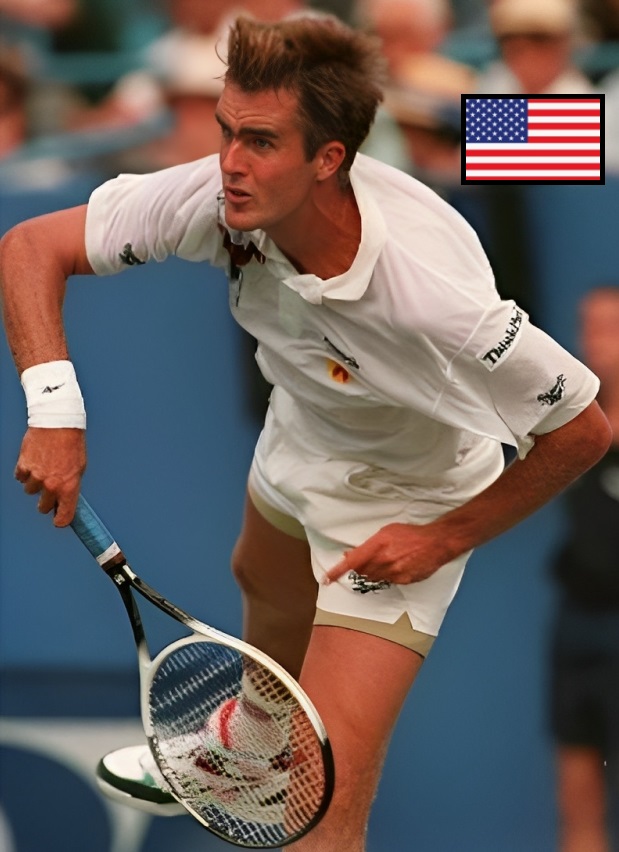
Todd Martin
Born: July 8, 1970 in Hinsdale (Illinois)
Height: 1.98 m
Plays: Right-handed (two-handed backhand)
My first sighting of the almost two-meter-tall Martin was at the US Open ’92. At the main arena, during the night session, he lost to a one-year-younger yet much more experienced Pete Sampras. Still, my overall impression was that Martin could have emerged victorious; it came down to just a few crucial points. It surprised me that a 22-year-old player with such a powerful serve, excellent net coverage, and exquisite returns, had just broken into the Top 100 before the Open.
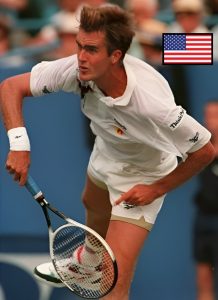 The following year confirmed Martin’s immense potential as he soared from No. 90 to 13, delivering commendable results across all surfaces (even American clay, he played on European clay only in Paris). From late 1993 to early 1997, Martin was perceived as a top 10’er, besting all the world’s top players in those years (aside from Jim Courier). However, the lack of clinching a significant title tarnished his career. A severe elbow injury sidelined him for eight months, plummeting his ranking from No. 12 to 81. After the resurgence, with first grey hair in the years 1998-99, he was arguably better than ever regarding his consistency on every surface and ability to win tight matches on a regular basis (the best results he had in 1994).
Despite clay being his weakest surface, Martin secured presumably his most significant title after a two-year hiatus from his previous win – Barcelona ’98. What’s even more remarkable, it is his convincing victory in Barcelona over six players who excelled on clay. Martin was an exceptional fighter, rallying back nine times from 0-2 down in sets (the most memorable vs Greg Rusedski at the US Open ’99). Yet, he also suffered unimaginable defeats on Centre Court at Wimbledon against fellow Americans: MaliVai Washington (1996) and Andre Agassi (2000), losing those matches despite holding a double-break advantage in fifth sets.
Regarding his serve, although his towering height was somewhat misleading due to his larger head, Martin was never considered among the best servers; he knew how to swiftly secure service games with a mix of aces, service winners, and volleys though. Well-regarded among his peers, he was elected president of the ATP in 1998. The presidency featured his second career phase, where regularity in achieving good results in the early 00s proved elusive compared to his pre-injury form of the mid 90s. Nevertheless, as a seasoned veteran, he secured his second Grand Slam final at the US Open ’99, where he led 2-1 in sets against Agassi.
From a historical standpoint, I rank Martin alongside Cédric Pioline in the tennis hierarchy (6-4 for Martin in matches between them), although the Frenchman secured one big title while Martin narrowly missed out. Martin’s prime opportunity arose in Montreal ’93, but despite seemingly having the title within his grasp, he fell short against Mikael Pernfors.
Sampras remained Martin’s toughest rival, boasting an 18-4 Head-to-Head record against him. “I always joke (that) I beat him four times, (but) don’t ask me how many times I played him. Because he truly dominated me. I just so happened to not be dominated the way I could have been dominated.” stated Martin many years after finishing his career. However, other serve-and-volleyers struggled against Martin due to his equally efficient groundstrokes from both wings. Great players like Stefan Edberg (Australian Open 1994) and Boris Becker (Munich 1995) discovered this challenge when facing Martin, among others.
In an interesting trivia note, despite both “towers” Martin and Marc Rosset competing on the tour throughout the ’90s, they never crossed paths in singles matches! However, they did encounter each other once on the doubles court at Indian Wells ’96, where Martin and his partner secured victory with a 7-6 triumph in the third set.
Career record: 411–234 [ 230 events ]
Career titles: 8
Highest ranking: No. 4
Best GS results:
Australian Open (runner-up 1994; quarterfinal 1999 & 2001)
Wimbledon (semifinal 1994, 1996; quarterfinal 1993 & 1999)
US Open (runner-up 1999; semifinal 1994 & 2000)
Davis Cup champion 1995 (played doubles in the final)
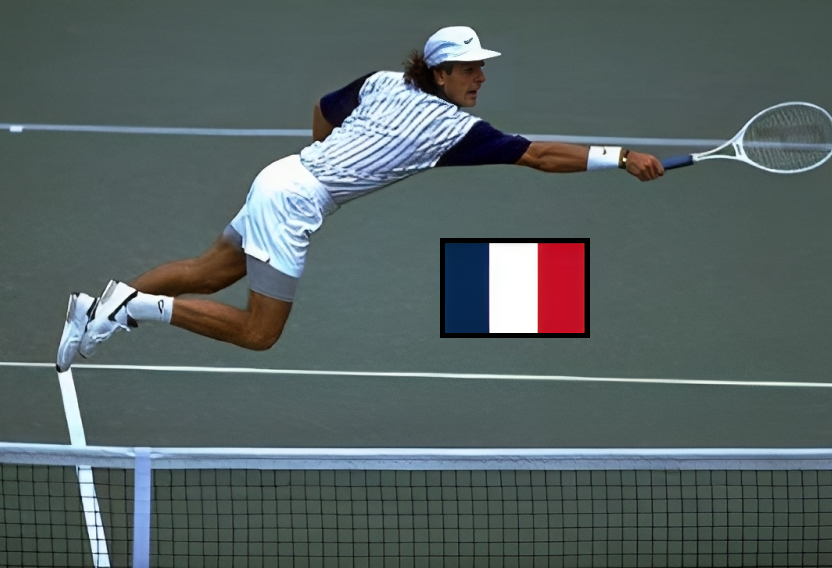
Cédric Pioline
Born: June 15, 1969 in Neuilly-sur-Seine (Île-de-France)
Height: 1.89 m
Plays: Right-handed
Arguably the best Frenchman in the 90s, but not the crowd favorite; I recall his Toulouse ’93 final when he faced Arnaud Boetsch, just two months older. Surprisingly, almost the entire stadium cheered for Bœtsch, despite neither of the Frenchmen hailing from the south of France; both were born in cities near Paris. Unlike other prominent French players born in the 60s, such as Yannick Noah, Guy Forget, Henri Leconte, he hadn’t secured interesting victories during his teenage years, making it difficult to anticipate notable achievements on the ATP Tour, therefore Fédération Française de Tennis didn’t support him in the late 80s.
In my view, the turning point in Pioline’s career emerged at the US Open ’92. At 23 years old, he engaged in a gruelling four-set match against the era’s top player, Jim Courier. Pioline gained confidence from that defeat, subsequently reaching his first final in Lyon, followed by a remarkable advancement to the Monte Carlo and US Open finals (he avenged his loss to Courier on the same court). With a burden of misfortune in the finals, he needed to participate in as many as 148 main-level events before finally claiming his maiden title in Copenhagen on his tenth final attempt. Among the nine successive lost finals, 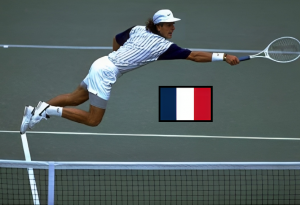 he was considered a clear favorite only once, and was stunned by the powerful serving of Jonathan Stark in Bolzano.
Ultimately, Pioline concluded his career with five titles, the most prestigious being Monte Carlo ’00. Although he didn’t defeat any top-ranked players then, all six defeated opponents had already established recognizable positions in the tennis world. Regarding his playing style, it’s worth noting that perhaps the most challenging shot in tennis (excluding reflex shots), the backhand overhead, could be considered his trademark. The son of volleyball players, with his mother hailing from Romania, had an innate ability to leap using both legs, and while his classical overhead might not have been as spectacular as Pete Sampras‘, it was an efficient shot. Pioline’s one-handed topspin backhand stood as a rock-solid stroke, serving as the precursor to a shot highly valued in Stan Wawrinka‘s game more than a decade later.
Pioline demonstrated adeptness in both serve-and-volley, evident in his journey to the biggest grass-court final, and an offensive baseline style, displayed notably in reaching the French Open ’98 semifinal. Pioline excelled as a tie-break specialist in 1999, ending the season with a 30-12 record (71%); he illustrated his versatile skills and mental resilience by defeating two much younger players in the ‘best of five’ format with the help of tight tie-breaks, both of whom would rise to become the best in the world soon: Gustavo Kuerten at the US Open and Lleyton Hewitt in the Davis Cup final.
Interestingly, similar to Miloslav Mečíř, Pioline swiftly lost both major finals to the most dominant player of the decade. Mečíř fell to Ivan Lendl (the best player of the 80s) at the US Open ’86 and the Aussie Open ’89, while Pioline faced Sampras (the best player of the 90s) at the US Open ’93 and Wimbledon ’97 (in both finals, Pioline was overwhelmed by Sampras’ serves). Combined, the Lendl-Mečíř finals lasted 3 hours and 54 minutes, whereas the Sampras-Pioline finals totalled 3 hours and 38 minutes. The Frenchman was the only notable player in the 90s who used an aluminium racquet. However, in 1996, he made a switch from the Prince “Magnesium Pro 90” (specially painted white for him, visible in the photo) to the Head “Radical Tour”. In the last few years of his career, he relied on the Dunlop “Muscle Weave 200G”. Personally, I regard him as the most adept player of the 90s among those who never graced the season-ending championships – he came remarkably close in 1993, being just two points away in the Antwerp semifinal as he faced his toughest opponent, Sampras (0-9 in their meetings, the same against Boris Becker; Pioline was close to beating both on two separate occasions, including a memorable Wimbledon ’95 quarterfinal when he lost 7-9 in the 5th set – the same score in the decider was repeated a year later in a match which would give Pioline the biggest satisfaction as he was two points away from clinching the Davis Cup title for France.
Career record: 389–318 [ 306 events ]
Career titles: 5
Highest ranking: No. 5
Best GS results:
Roland Garros (semifinal 1998; quarterfinal 1996)
Wimbledon (runner-up 1997; quarterfinal 1993, 95 & 99)
US Open (runner-up 1993; semifinal 1999)
Davis Cup champion 1996 and 2001 (played only doubles in the final)
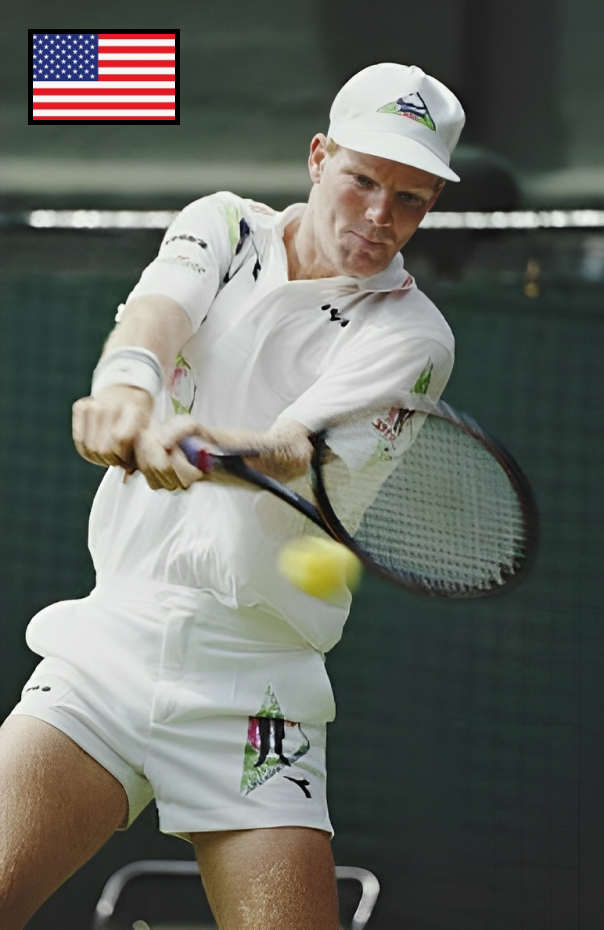
Jim Courier
Born: August 17, 1970 in Sanford (Florida)
Height: 1.85 m
Plays: Right-handed (two-handed backhand)
Raised in Dade City, a quaint town with a population of 6.5 thousand, Courier’s journey into tennis was initiated by Emma Spencer. She was his great aunt and proprietor of the ‘Dreamworld Tennis Club’ in Sanford. “In the early days, tennis was simply a fun family activity, and I didn’t harbor grand aspirations,” Courier remarked. “We caught glimpses of tennis on television, but it wasn’t a professional pursuit I had in mind. I wasn’t the kid pretending to win Wimbledon against a wall, as you often hear about.”
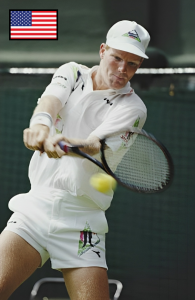 At the age of 14, Courier transitioned to Nick Bollettieri‘s domain, joining the ranks of the most promising boys at the academy alongside Andre Agassi, his roommate, and the slightly older David Wheaton. Despite excelling as a junior, securing the Orange Bowl under-16 and under-18 titles in 1986 and 1987 respectively, the media spotlight was focused on other U.S. teenagers, such as Agassi, Michael Chang, and Pete Sampras, who later became Courier’s doubles partner. Concluding the year 1990, Courier stood fourth among these talented youngsters, but the onset of the 90s saw his ascendancy. He held the top position in the tennis world for over two years, spending a total of 58 weeks at No. 1 during four distinct periods from 1992 to 1993.
Courier’s rise to the top commenced with a triumph at the Sunshine Double: Indian Wells–Key Biscayne in March ’91. However, the following week he suffered a surprising setback in his Davis Cup debut against Mexico at very high altitude, losing to Leonardo Lavalle and Luis Herrera, both top-50 level players. Despite this, the American team clinched the tie 3-2, and in the following 13 ties where Courier participated, the team remained undefeated, until their failure in 1999 against the Australians. At the age of 22, Courier became the youngest player to reach finals in all four majors, an achievement not seen since Rod Laver in 1969. His feat of reaching the finals of the Australian, French, and Wimbledon in the same season wasn’t equalled until Roger Federer accomplished it in 2006.
Courier’s dominance was characterized by his western-grip topspin forehand (this grip was gaining popularity in the early 90s), “baseball backhand” (short backswing) and exceptional physical fitness, a mental hammer for his opponents. His forehand was a consistent threat, wearing down opponents from the baseline or executing precise passing-shots. Stefan Edberg, the ranking leader of 1990-91, couldn’t handle those heavy passing-shots; he succumbed to Courier in four major defeats across three different venues (always in four sets), a trend that continued between 1991-93, even at Wimbledon, where Courier’s groundstrokes seemingly would be less effective.
1992 marked a pinnacle for Courier, as he ascended to the top the tennis pyramid, reaching the San Francisco final. Recalling his semifinal against Derrick Rostagno, Courier remarked: “I was very aware of the situation and just wanted to secure the top spot for one week. Derrick was a tricky and dangerous fast-court player, and I had to grind my way through that match to reach No. 1. Battling Derrick and the rankings was both a relief and a thrill to win that last point and claim the top spot.”
However, despite this achievement, his initial weeks at the top exposed vulnerabilities, particularly his inability to clinch matches in tense situations. Courier appeared composed like Björn Borg, but something crucial seemed absent from his game. His defeats when holding match points against Boris Becker (unbelievable final in Brussels) and Goran Ivanišević (Stuttgart, QF) were telling. Despite this, Courier evaded tense situations on clay in 1992. After winning two Asian titles on hard courts (Tokyo & Hong Kong), Rome, and the French Open for the second consecutive year, he was seen as a contender at Wimbledon. However, he was ousted by qualifier Andrey Olhovskiy (b. 1966), ending his 25-match winning streak. This loss was a significant morale blow, particularly as fellow offensive-baseliner Agassi clinched the Wimbledon title that year; the edition being relatively low on rain, thus more favorable for players accustomed to hardcourts.
During the latter part of the season, Courier grappled with form issues, including a shock loss at the Olympics in Barcelona on clay to Marc Rosset, where Courier was the main favorite for the gold medal. Nonetheless, the year ended triumphantly with a “Masters” final and a Davis Cup victory, sealing the final match. However, the following year started similarly to the previous one, with Courier securing an Australian Open title after vanquishing Edberg in another final. Subsequently, he reached the French Open and Wimbledon finals, losing to Sergi Bruguera and Sampras respectively, after which his career trajectory changed. The Swedes, Borg and Mats Wilander experienced burnouts at 24, Courier, one year younger, experienced a similar, albeit lesser, downturn. Although reaching two major semifinals in 1994, he didn’t secure a title that year, dropping out of the Top 10. The subsequent year witnessed a partial resurgence for Courier. However, his former doubles partner Sampras, who had overtaken him, remained beyond his reach. From Hong Kong ’93 to Rome ’97, they met ten times and Sampras left the court nine times as a victor. The following decade would bring something similar in Federer’s confrontations against Lleyton Hewitt & Andy Roddick; those are examples when a more gifted player simply has all the answers against very tough opponents who try everything, only to fail, even when the score is tight… In the second half of the 90s, Courier turned into a very solid, yet predictable player. Actually after Roland Garros ’94 when lost his status of the ‘King of Clay’ after a second straight defeat to Bruguera on Centre Court in Paris, he was never considered as a major threat; to the end of his career he was claiming titles only in tournaments corresponding with today’s ‘ATP 500’ or ‘ATP 250’. He decided to quit at the beginning of 2000 when he almost turned thirty. In the years 2010-18 he served as a captain of the Davis Cup team for the United States. Courier led his country with a modest 10-8 record during his captaincy (two semifinals). Trivia: he lost his first five meetings against Andrey Chesnokov, 4-6 in the end (four of those defeats when Courier was within a few points from winning).
Career record: 506–237 [ 241 events ]
Career titles: 23
Highest ranking: No. 1
Best GS results:
Australian Open (champion 1992-93; semifinal 1994; quarterfinal 1995-96)
Roland Garros (champion 1991-92; runner-up 1993; semifinal 1994; quarterfinal 1996)
Wimbledon (runner-up 1993; quarterfinal 1991)
US Open (runner-up 1991; semifinal 1992 & 95)
Masters runner-up 1991-92
Davis Cup champion 1992 & 95
Year-end ranking 1987-00… 346 – 43 – 24 – 25 – 2 – 1 – 3 – 13 – 8 – 26 – 21 – 77 – 32 – 290
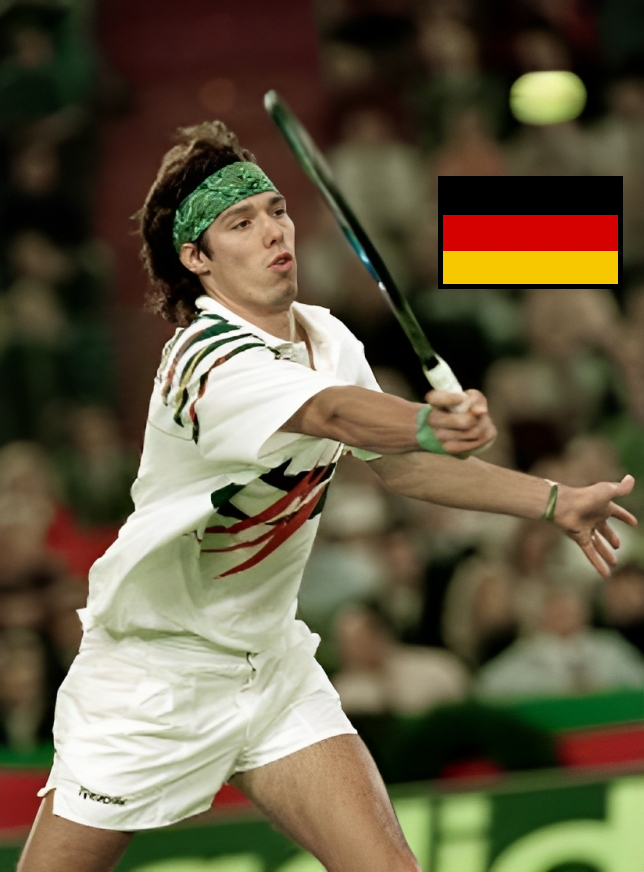
Michael Stich
Born: October 18, 1968 in Pinneberg (Schleswig-Holstein)
Height: 1.93 m
Plays: Right-handed
The second-best German player of the Open Era, following Boris Becker, yet his initial years on the tour didn’t hint at this status. The ’80s and ’90s marked the period when many top players established themselves successfully from their teenage years, but Stich was an exception. Amid West Germany’s triumphs in the 1988-89 Davis Cup, which saw the emergence of Becker and Carl-Uwe Steeb (both from Baden-Württemberg, a southern region of Germany and both a year older than Stich), the man from northern Germany, didn’t feature in any rubber across eight ties. Instead, Eric 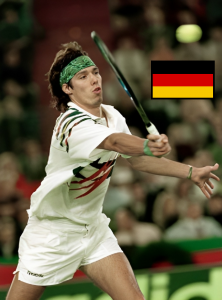 Jelen and Patrik Kühnen were considered doubles specialists who might replace the leading singles players. It seemed improbable that the fifth-best German player of that era would lead Germany to its third Davis Cup (first since the reunification) title in 1993!
Stich made his mark on the tour in February ’90, triumphing in Memphis as world number 80. Although he won six matches, he didn’t defeat any particularly notable opponents; the highest-ranked player he overcame was Andrey Chesnokov [19], who wasn’t known for indoor play. “It’s a great feeling,” said Stich about securing his first title. “I don’t really know what happened out there. But I’m sure I’ll recognise what happened some days from now. There aren’t that many German players who have won Grand Prix titles. Maybe I’ll get some recognition,” he remarked. And recognition he received! A few weeks later, Niki Pilić nominated him for a Davis Cup tie in Argentina; however, Stich lost in five sets to Martín Jaite. Their second-round encounter at Roland Garros two months later, extended to 4 hours and 46 minutes, making it one of the longest matches of the year. Despite Stich’s impressive improvement in the following years, his loss to Jaite highlighted the weakest aspect of his tennis – the inability to play at his best when a match surpassed the three-hour mark; it was the most emphasized as Stich lost a Davis Cup ’95 rubber to Chesnokov squandering nine match points on serve (!) in one game – an unprecedented moment in the Open Era. In 1990, during the US Open, the German for the first demonstrated his big potential by pushing Ivan Lendl to a hard-fought four-set victory. Lendl acknowledged Stich’s pressure, stating: “He pushes and pushes, and then he sneaks in on an unusual shot. He puts a lot of pressure on you that way.” The next year they played a five-setter on the same court.
The classical serve-and-volleyer was evolving, becoming more patient and enhancing his ground-strokes. The breakthrough came in January ’91 – Stich reached two Australian finals (Adelaide, Sydney) and progressed to the third round at the Australian Open, where he faced the best server of the time, Guy Forget, losing in a tight four-set match.
Maintaining his form after the Australian events, a series of notable results, including unexpected clay-court semifinals (Hamburg, French Open), led him to the tournament of his life – Wimbledon. In a miraculous fourth-round match against Alexander Volkov, Stich turned the tables after trailing *1:3 (30/40) in the deciding set. His incredible recovery against Volkov relieved him of any pressure in subsequent matches. Stich’s relaxed demeanor contributed to his victories against three top players – Jim Courier, Stefan Edberg, and Becker in the final – not based on rankings. Particularly notable was the match against Edberg; never before had a player in a ‘best of 5’ format failed to break an opponent’s serve prevailing anyway. This novelty in the ’90s brought attention, along with another significant match versus Richard Krajicek at the Aussie Open ’92 – a tight five-setter with only three breaks of serve, a rare occurrence at the time. Stich epitomized the all-serve player, someone primarily focused on maintaining the serve. The inability to break the opponent’s serve wasn’t a concern due to the tie-break rule at 6-all.
Stich was part of a league of players in the early ’90s, including Pete Sampras, Goran Ivanišević, and Krajicek, renowned for their ability to sustain their serves on faster surfaces. He triumphed over them in gripping serve-and-volley clashes during the 1993 indoor finals (Stuttgart, Stockholm, and Frankfurt), marking a unique feat in the Open Era by winning at least 30 tie-breaks within a season. He engaged in compelling matches against other formidable servers of the time – notably against Forget at the Hopman Cup, where he hit 31 aces in a three-set match, an unprecedented occurrence at that time. Additionally, his encounters with David Wheaton in Munich ’91, and Becker at Wimbledon ’93 added to the list of his remarkable matches displaying his mindset.
The year 1993 stood out for Stich; not only was he playing exceptionally well across tournaments, but he also found himself in unprecedentedly intense situations. He played a record number of matches for his country, participating in 15 singles matches: three at the Hopman Cup (title), four at the World Team Cup (runner-up), and eight at the Davis Cup (title). He bid farewell in style, reaching the Wimbledon ’97 semifinal at just 28 years old. However, a severe injury sustained in Vienna ’95 resulted in permanent ankle issues for the next two seasons. Despite this setback, his exceptional talent shone through even on clay, eliminating Thomas Muster, the primary favorite for the title, at the French Open ’96.
Career record: 385–176 [ 179 events ]
Career titles: 18
Highest ranking: No. 2
Best GS results:
Australian Open (semifinal 1993; quarterfinal 1992)
Roland Garros (runner-up 1996; semifinal 1991)
Wimbledon (champion 1991; semifinal 1997; quarterfinal 1992-93)
US Open (runner-up 1994; quarterfinal 1991)
Masters champion 1993
Grand Slam Cup champion 1992
Davis Cup champion 1993
World Team Cup champion 1994
Hopman Cup champion 1993
…from John McEnroe to Kei Nishikori…
 …next year, I won’t be comparing seasons 1994 and 2024. Instead, I plan to post short biographies that I’ve written for my e-book “…from Phil Dent to Jannik Sinner…” (published in March 2021) focusing on the best singles players of the Open Era. I’ve included 340 short biographies in the e-book and intend to share over 100 on my website. These will be slightly modified versions, adjusted to suit my website and hyperlinked. This project will be titled
“…from John McEnroe (b. 1959) to Kei Nishikori (b. 1989)”
aiming to showcase the best players of the past forty years, spanning the most successful individuals from the 1980s, 90s, 00s, and 10s. This year in December, I’ve already posted fifteen biographies. Next two years, I aim to post between 3 to 7 biographies each month. Whether it’ll be completed within those two years remains uncertain; it largely depends on potential retirements. Notably, ten very good/great players born in the 80s are still active as of the end of 2023. You can find the links to the biographies here. Additionally, I’ll continue to post picture-stats of the most significant matches from the Open Era. Furthermore, I’ll keep posting pic-stats of Federer’s finals. As of the end of 2023, there are 138 out of his 157 finals available on my website; I guess the remaining 19 finals will be posted by the end of 2025. This means 87% of his finals are wrapped up, it’s 84% in Đoković’s case, 83% in Nadal’s.
Posted in Tournaments
Leave a comment