Stan Wawrinka
Born: March 28, 1985 in Lausanne [Romandie]
Height: 1.83 m
Plays: Right-handed
Born as Stanislas, he has Czecho-Polish ancestry from the side of the father, but his surname suggests to me that his Czech grandfather had Polish roots, and the surname was initially written Wawrzynka (“laurel”, which is quite funny because Roger Federer’s wife – Miroslava Vavrincová – has a maiden name derived from the same word).
Usually when I watch young players at the beginning of their careers, I know more or less what they would achieve in the future. I mean I think “this one should win one major, that one should advance to the Top 20” etc., and often I’m right within a minimum of what I had predicted. Wawrinka totally fooled me though, and he did it many times. When I was watching his advancement to the Rome ’08 final, I thought it was his career-best result. He was 23 y.o. then, ranked 24, and defeated three former (and one future) Nos. 1, but those former best players (Marat Safin, Juan C. Ferrero) were already past their prime, so the Swiss player didn’t impress me. Later that year he helped Federer win the gold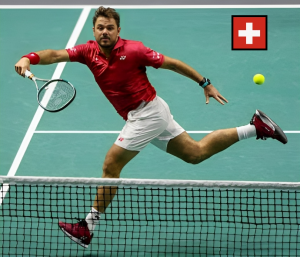 medal at the Olympics in Beijing in doubles, so it was something not anticipated at all, but not very strange either, given Federer’s amazing form in those years and Wawrinka’s good skills overall with a one-handed backhand distinctly above the average (six years later they would win the Davis Cup for Switzerland).
When he reached the US Open ’10 quarter-final, aged 25, many people would have assumed it was a bar he wouldn’t overcome in the future. And indeed, he lost another two major quarter-finals, but in 2013 he underwent a metamorphosis. He began to work with Magnus Norman (former No. 2 in the world), and even though he lost an epic 4th-round encounter against Novak Đoković in Australia, it worked as an enormous confidence booster because the best player in the world was actually helpless for the first hour of that memorable encounter. Wawrinka lost to Đoković another complex five-setter in the US Open ’13 semi-final; it only confirmed him in the conviction that he belonged among the best players in the world…
Australian Open ’14… a tournament which completely rewrote the career of the francophone Swiss. When he began it, his records against the best players in the world looked depressing: 14 straight defeats to Đoković, 0-12 vs Rafael Nadal, 1-13 Federer. He was already 29, so actually I was close to fulfilling my prediction from 2008. Wawrinka somehow managed to beat Đoković in the quarter-final, and he did the same to an injured Nadal in the final. Quite shocking was his reaction too: he didn’t lie on the court in disbelief, just raised his hand like many times before when winning incomparably less important matches. “For me it is the best Grand Slam ever,” said Wawrinka holding the trophy. “Last year I had a crazy match, lost it and was crying a lot after the match. In one year a lot happened. Right now I still don’t know if I’m dreaming or not, but we’ll see tomorrow morning.” I automatically associated that success with those achieved by Andrés Gómez, Petr Korda & Thomas Johansson, the examples of players who had plenty of experience and suddenly, at the latter stages of their careers, won the sweetest trophies in tennis. Wawrinka’s following major only validated my estimation – he lost in Paris already in the first round, even though fully confident after he had triumphed on clay in Monte Carlo (his lone Masters 1K title), which put him among the favourites in Paris.
What he couldn’t do in 2014, he achieved in 2015 – playing in quite specific shorts, he overpowered Đoković in the Parisian final; he did the same to the Serb one year later in the final at the US Open – all of a sudden a guy who should have been happy with one Slam semifinal, has three major titles, and three claimed at different venues! A total shocker: Wawrinka, known for many years as someone rather a bit behind guys like David Ferrer, Jo-Wilfried Tsonga & Tomáš Berdych (each of them reached one major final), suddenly put himself in a rivalry against Andy Murray, the weakest link of the Big 4! Of course Wawrinka couldn’t be compared to Murray in terms of major finals, but the Swiss equalled the achievement of the Scot in the number of those most prestigious titles, and defeated him in the French Open ’17 semi-final – one of the best clay-court five-setters I’ve ever seen, which allows an alternative look at the best players of the 2010s: Big 3, then Murray/Wawrinka, then the rest of the peloton (using the cycling terminology).
Wawrinka’s natural athleticism allowed him to stay on the tour until he turned 41 even though he lost his status of an elite player aged 36. A foot injury early in 2021 didn’t discourage him to come back after a twelve-month hiatus. Admittedly in the last few years of his career he lost many matches “he shouldn’t have lost” to much inferior players; he came back after two decades to playing at the Challenger level to keep a decent ranking, but from time to time he surprised the best players either defeating them or playing on equal terms against them, and at the age of 38 he took part in his last ATP final (Umag), four years after the previous one. Even in the last year of his career with a low ranking, he helped Switzerland reach the United Cup final, and during Wimbledon he took part in something which will be remembered as one of the longest tie-breaks played in Wimbledon history as he lost an all-four-set tie-break contest to Matteo Berrettini. There have been many players capable of dominating their opponents with forehand and backhand groundstrokes. Wawrinka is a unique example of a player who was able to achieve the same thing using a one-handed backhand.
His career could have been even more extraordinary had he triumphed at Wimbledon at least once. Grass, however, was his most challenging surface – he reached only one ATP final on it. In my view, Wawrinka was not an exceptional returner (he often employed a forehand block, a shot that was already not common at his times when this surface slowed down), which made breaking his opponents’ serves on grass more difficult for him than on any other surface. Nevertheless, he came tantalizingly close to reaching the Wimbledon semifinals once (2015).
Career record: 590-395 [ 390 events ]
Career titles: 16
Highest ranking: No. 3
Best GS results:
Australian Open (champion 2014; semifinal 2015 & 17; quarterfinal 2011 & 20)
Roland Garros (champion 2015; runner-up 2017; semifinal 2016; quarterfinal 2013 & 19)
Wimbledon (quarterfinal 2014-15)
US Open (champion 2016; semifinal 2013 & 15; quarterfinal 2010, 14 & 19)
Davis Cup champion 2014
Olympic gold medal in doubles (2008)
This entry was posted in
Players. Bookmark the
permalink.


Activity: 2003 – 2026
Five-setters: 31-27 (53%)
Tie-breaks: 276-259 (52%)
Deciding 3rd set TB: 31-19 (62%)
Defeats by retirement: 9
Walkovers given: 4
Longest victory: French Open ’19 (4R)… Stefanos Tsitsipas 7-6, 5-7, 6-4, 3-6, 8-6 … 5 hours 9 minutes
Longest defeat: Aussie Open ’13 (4R)… Novak Đoković 6-1, 5-7, 4-6, 7-6, 10-12… 5 hours 2 minutes
MP matches: 8-11
Two-point away matches: 19-17