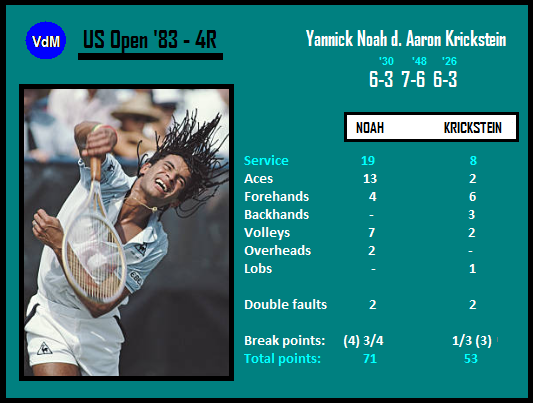
Stats of the last two sets: number of aces, double faults and break points valid for the entire contest
Points won by each set: | X, 39-32, 32-21 |
Unreturned serves (sets 2 and 3):
41 % Noah – 26 of 63
16 % Krickstein – 15 of 61
The 16-year-old Krickstein [489, wild card], shortly after enjoying the US junior championship, became the youngest player in the 4th round of a Slam after two five-set victories (in the first round he ousted one year older Edberg, 6-3, 6-2, 3-6, 4-6, 7-6, who was no. 100 at the time!), but the high temperature (36°C) and the massive crowd (Stadium Court) meant too much for him physically and mentally; already at the beginning of the 2nd set he seemed very tired & irritated, yet he managed to lead 3:0* in that set. In the 7/2 tie-break, Noah [4], the then French Open champion, won a point of the tournament when he made a lob between the legs only to respond to Krickstein’s overhead with a forehand passing-shot winner on the run! “Yeah, just for fun. If you’re playing five hours a day and it becomes boring, you try it.”, explained the Frenchman how he was developing skills to play such a unique shot. At the time he and Vilas were the only two players able to deliver this type of a shot. In his next tournament, Krickstein claimed his first Grand Prix title (Tel Aviv) becoming the youngest champion; his top-spin forehand was awesome, but in the mid 80s there was a transition in tennis equipment so Krickstein took an advantage of facing much older players who still used wooden racquets or tried to adapt to the new technology while he was naturally holding one of the first graphite “Wilson” models. People thought he’d be a multiple Slam champion, he wouldn’t even play one final at this level though. Before the US Open ’83, the American teenage sensation had played four main-level tournaments, always losing his opening match.

Stats of the last two sets: number of aces, double faults and break points valid for the entire contest
Points won by each set: | X, 39-32, 32-21 |
Unreturned serves (sets 2 and 3):
41 % Noah – 26 of 63
16 % Krickstein – 15 of 61
The 16-year-old Krickstein [489, wild card], shortly after enjoying the US junior championship, became the youngest player in the 4th round of a Slam after two five-set victories (in the first round he ousted one year older Edberg, 6-3, 6-2, 3-6, 4-6, 7-6, who was no. 100 at the time!), but the high temperature (36°C) and the massive crowd (Stadium Court) meant too much for him physically and mentally; already at the beginning of the 2nd set he seemed very tired & irritated, yet he managed to lead 3:0* in that set. In the 7/2 tie-break, Noah [4], the then French Open champion, won a point of the tournament when he made a lob between the legs only to respond to Krickstein’s overhead with a forehand passing-shot winner on the run! “Yeah, just for fun. If you’re playing five hours a day and it becomes boring, you try it.”, explained the Frenchman how he was developing skills to play such a unique shot. At the time he and Vilas were the only two players able to deliver this type of a shot. In his next tournament, Krickstein claimed his first Grand Prix title (Tel Aviv) becoming the youngest champion; his top-spin forehand was awesome, but in the mid 80s there was a transition in tennis equipment so Krickstein took an advantage of facing much older players who still used wooden racquets or tried to adapt to the new technology while he was naturally holding one of the first graphite “Wilson” models. People thought he’d be a multiple Slam champion, he wouldn’t even play one final at this level though. Before the US Open ’83, the American teenage sensation had played four main-level tournaments, always losing his opening match.