Points won by each set: | 33-24, 28-35, 30-18 |
Unreturned serves:
37 % Doumbia – 29 of 77
34 % Nelson – 31 of 91
Only a few months after the first all-black final had taken place, another one was witnessed, completely unexpected as opposed to the first one. 25-year-old Doumbia [453], a pro for two years, was a qualifier, two years older Nelson [119] barely avoided playing the qualifying rounds. Neither of them was young in terms of tennis age, therefore it seemed like a lifetime opportunity to get the only title of their careers. Neither of them was a total fluke in the end-match that week because they eliminated the top seeded players (Doumbia ousted Chesnokov in 1R, Nelson upset Noah in the semifinals). Both black players applied the same strategy facing each other, mainly attacking the net behind each serve with occasional elements of surprise – staying back after a big first serve. Doumbia, who lived in France, could count on bigger support, but it wasn’t the only factor which helped him to prevail; his technique was more fluid actually in each department. He broke in games 3 and 8 of the sets he won, Nelson broke leading 2:1 in the middle set. The American had an outlook to win that match anyway, there was 3-all in the decider when he created a break point and Doumbia missed his first serve… The Senegalese made two records: the lowest ranked titleist (it’ll be overcome ten years later), the first man to win a main-level title in his debut (Jose Francisco Altur will do the same one year later in San Marino).
Doumbia’s route to his maiden title (main-level debut!!):
1 Andrey Chesnokov 7-6, 7-6
2 Jerome Potier 6-7, 6-3, 6-1
Q Jeremy Bates 6-3, 7-5
S Eduardo Masso 6-4, 7-6(5)
W Todd Nelson 6-4, 3-6, 6-3
Points won by each set: | 33-29, 34-30 |
Unreturned serves:
24 % Doumbia – 17 of 69
31 % Hlasek – 18 of 57
Hlasek’s tennis looked archaic in the mid 90s, he dropped outside the Top 100. It was frustrating for a former top 10 player, he was pondering retirement, but he changed his racquet (from “Fischer” to “Wilson”) and decided to play more risky shots to shorten the rallies at the age of 30 when he realised he became a slower player. After the Gstaad final he reached an L.A. semifinal, therefore he must have been considered a favorite against the low ranked qualifier whom had defeated twice in the past. Hlasek [73] tried to be pro-active as both: server and receiver, but almost every time when his approach-shot or volley was shorter, Doumbia could have passed him with his forehand. The outsider was calm and collected; throughout the match, Doumbia [282] repeatedly adjusted his sleeve to showcase his left shoulder. Hlasek significantly helped him because in the opener he lost his serve at 4-all committing his all double faults. In the 2nd set Doumbia got another break at 1-all. The last game of the final was the longest: four deuces, Hlasek had a few break points, ultimately Doumbia decided to play S/V for the first time behind his second serve, and forced an error with his volley.
Doumbia’s route to his 2nd and last title:
[ Ketola 7-5, 6-2; Jonsson 6-1, 6-3; Champion 6-4, 6-2 ]
1 Rodolphe Gilbert 6-2, 6-4
2 David Prinosil 6-3, 6-2
Q Guillaume Raoux 6-2, 6-2
S Lionel Roux 6-4, 6-2
W Jakob Hlasek 6-4, 6-4
☆ It’s actually inexplicable that Yahiya Doumbia, a Senegalese born in Mali and a graduate of Hampton University in Virginia, won two main-level titles in a span of seven years and in the meantime achieved no significant results apart from the Indianapolis quarter-final and Livingston semi-final in 1988. Afterwards he suffered 16 consecutive main-level defeats over three years. Both of his titles came in southern France (Lyon on carpet, Bordeaux on outdoor hard), he defeated only Top 100 or soon-to-be Top 100 players, and in both cases these titles were preceded by his appearances in Satellites – the lowest level of professional tennis – mixed with sporadic Challengers and attempts to qualify for main-level events. Winning Bordeaux ’95 (in the space of two months Doumbia rose from world No. 753 to 149) changed nothing in the final years of his career. Hampered by tendinitis in his knee and later his arm, as well as problems with his eyes, he remains a tennis mystery. Perhaps he was a victim of the non-existent ATP events in Africa, where he might have received wild cards as the best black player on the continent. Doumbia played in 26 Davis Cup ties for Senegal between 1984 and 1999.

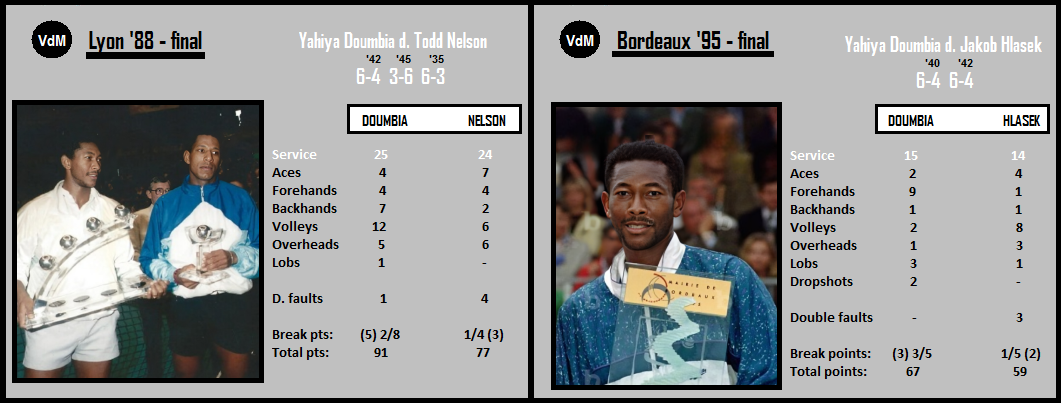
Points won by each set: | 33-24, 28-35, 30-18 |
Unreturned serves:
37 % Doumbia – 29 of 77
34 % Nelson – 31 of 91
Only a few months after the first all-black final had taken place, another one was witnessed, completely unexpected as opposed to the first one. 25-year-old Doumbia [453], a pro for two years, was a qualifier, two years older Nelson [119] barely avoided playing the qualifying rounds. Neither of them was young in terms of tennis age, therefore it seemed like a lifetime opportunity to get the only title of their careers. Neither of them was a total fluke in the end-match that week because they eliminated the top seeded players (Doumbia ousted Chesnokov in 1R, Nelson upset Noah in the semifinals). Both black players applied the same strategy facing each other, mainly attacking the net behind each serve with occasional elements of surprise – staying back after a big first serve. Doumbia, who lived in France, could count on bigger support, but it wasn’t the only factor which helped him to prevail; his technique was more fluid actually in each department. He broke in games 3 and 8 of the sets he won, Nelson broke leading 2:1 in the middle set. The American had an outlook to win that match anyway, there was 3-all in the decider when he created a break point and Doumbia missed his first serve… The Senegalese made two records: the lowest ranked titleist (it’ll be overcome ten years later), the first man to win a main-level title in his debut (Jose Francisco Altur will do the same one year later in San Marino).
Doumbia’s route to his maiden title (main-level debut!!):
1 Andrey Chesnokov 7-6, 7-6
2 Jerome Potier 6-7, 6-3, 6-1
Q Jeremy Bates 6-3, 7-5
S Eduardo Masso 6-4, 7-6(5)
W Todd Nelson 6-4, 3-6, 6-3
===================================================
Points won by each set: | 33-29, 34-30 |
Unreturned serves:
24 % Doumbia – 17 of 69
31 % Hlasek – 18 of 57
Hlasek’s tennis looked archaic in the mid 90s, he dropped outside the Top 100. It was frustrating for a former top 10 player, he was pondering retirement, but he changed his racquet (from “Fischer” to “Wilson”) and decided to play more risky shots to shorten the rallies at the age of 30 when he realised he became a slower player. After the Gstaad final he reached an L.A. semifinal, therefore he must have been considered a favorite against the low ranked qualifier whom had defeated twice in the past. Hlasek [73] tried to be pro-active as both: server and receiver, but almost every time when his approach-shot or volley was shorter, Doumbia could have passed him with his forehand. The outsider was calm and collected; throughout the match, Doumbia [282] repeatedly adjusted his sleeve to showcase his left shoulder. Hlasek significantly helped him because in the opener he lost his serve at 4-all committing his all double faults. In the 2nd set Doumbia got another break at 1-all. The last game of the final was the longest: four deuces, Hlasek had a few break points, ultimately Doumbia decided to play S/V for the first time behind his second serve, and forced an error with his volley.
Doumbia’s route to his 2nd and last title:
[ Ketola 7-5, 6-2; Jonsson 6-1, 6-3; Champion 6-4, 6-2 ]
1 Rodolphe Gilbert 6-2, 6-4
2 David Prinosil 6-3, 6-2
Q Guillaume Raoux 6-2, 6-2
S Lionel Roux 6-4, 6-2
W Jakob Hlasek 6-4, 6-4
Serve & volley: Doumbia 3/5, Hlasek 7/11
☆ It’s actually inexplicable that Yahiya Doumbia, a Senegalese born in Mali and a graduate of Hampton University in Virginia, won two main-level titles in a span of seven years and in the meantime achieved no significant results apart from the Indianapolis quarter-final and Livingston semi-final in 1988. Afterwards he suffered 16 consecutive main-level defeats over three years. Both of his titles came in southern France (Lyon on carpet, Bordeaux on outdoor hard), he defeated only Top 100 or soon-to-be Top 100 players, and in both cases these titles were preceded by his appearances in Satellites – the lowest level of professional tennis – mixed with sporadic Challengers and attempts to qualify for main-level events. Winning Bordeaux ’95 (in the space of two months Doumbia rose from world No. 753 to 149) changed nothing in the final years of his career. Hampered by tendinitis in his knee and later his arm, as well as problems with his eyes, he remains a tennis mystery. Perhaps he was a victim of the non-existent ATP events in Africa, where he might have received wild cards as the best black player on the continent. Doumbia played in 26 Davis Cup ties for Senegal between 1984 and 1999.