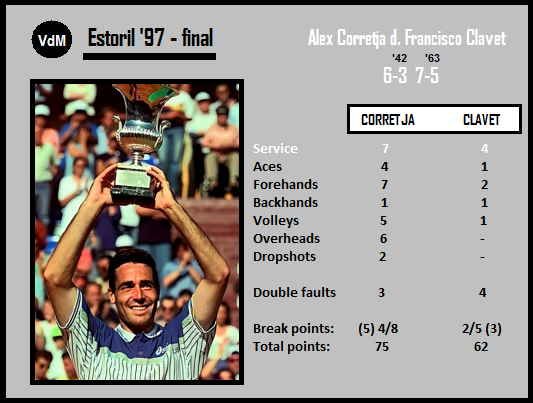
Points won by each set: | 32-26, 43-36 |
Unreturned serves:
15 % Corretja – 11 of 73
7 % Clavet – 4 of 64
I have a theory that an average professional player develops his game at the most important aspects until he’s 23-24 year-old (depending whether he becomes a pro as a teenager or a bit later). After that age it’s difficult to expect he’d be elevated to a higher level in tennis hierarchy. Corretja was 23 when he did it. He had won his first ATP match (Barcelona ’92) when he was just 17.11, two years later he was able to defeat top players of the early 90s (Becker, Courier, Edberg), in 1995 he stunned Muster in Gstaad when the Austrian was winning all clay-court matches before and after their meeting on clay, therefore it was strange that he couldn’t enter the Top 20. He was working on his first serve, top-spin backhand and the net-game, and it finally paid off in the years 1997-98 when he turned into a better player than initially had been expected from him. His consistency – which lasted almost two years – began in Portugal, as he quite comfortably claimed his first title in more than two years. In the final against his sparring session partner, an ultra defensive Clavet [35], he grabbed five games in a row in successive sets, trailing *1:3 in 1st and *2:5 in 2nd set (in that last set of the tournament there was already 0:3, 30/40). Following Estoril, Corretja [21] played two Mercedes Super 9 finals (Monte Carlo, Rome), and after waiting a few years to reach the Top 20, once he had done it, within a few weeks he became a Top 10 player.
Corretja’s route to his 2nd title:
1 Hernan Gumy 6-2, 6-3
2 Marcelo Filippini 6-4, 4-6, 6-1
Q Fabrice Santoro 6-3, 4-0 ret.
S Javier Sanchez 6-3, 6-1
W Francisco Clavet 6-3, 7-5

Points won by each set: | 32-26, 43-36 |
Unreturned serves:
15 % Corretja – 11 of 73
7 % Clavet – 4 of 64
I have a theory that an average professional player develops his game at the most important aspects until he’s 23-24 year-old (depending whether he becomes a pro as a teenager or a bit later). After that age it’s difficult to expect he’d be elevated to a higher level in tennis hierarchy. Corretja was 23 when he did it. He had won his first ATP match (Barcelona ’92) when he was just 17.11, two years later he was able to defeat top players of the early 90s (Becker, Courier, Edberg), in 1995 he stunned Muster in Gstaad when the Austrian was winning all clay-court matches before and after their meeting on clay, therefore it was strange that he couldn’t enter the Top 20. He was working on his first serve, top-spin backhand and the net-game, and it finally paid off in the years 1997-98 when he turned into a better player than initially had been expected from him. His consistency – which lasted almost two years – began in Portugal, as he quite comfortably claimed his first title in more than two years. In the final against his sparring session partner, an ultra defensive Clavet [35], he grabbed five games in a row in successive sets, trailing *1:3 in 1st and *2:5 in 2nd set (in that last set of the tournament there was already 0:3, 30/40). Following Estoril, Corretja [21] played two Mercedes Super 9 finals (Monte Carlo, Rome), and after waiting a few years to reach the Top 20, once he had done it, within a few weeks he became a Top 10 player.
Corretja’s route to his 2nd title:
1 Hernan Gumy 6-2, 6-3
2 Marcelo Filippini 6-4, 4-6, 6-1
Q Fabrice Santoro 6-3, 4-0 ret.
S Javier Sanchez 6-3, 6-1
W Francisco Clavet 6-3, 7-5
Serve & volley: Corretja 3/3, Clavet 0