Points won by each set: | 38-42, 36-25, 52-54, 28-16, 35-33 |
Points won directly behind the serve:
29 % Courier – 55 of 188
28 % Shelton – 48 of 171
The first day of the Aussie Open ’94, Centre Court, their only meeting, and a match which lasted 4 hours 42 minutes – for another 14 days of the event no pair of players would play longer. Courier [3] – among the elite players born in the 70s – was playing in the slowest pace on serve, already after the first two points of the match he needed 27 seconds to deliver another serve (!) despite the 20-second rule obligating at Slams since the beginning of the 90s decade. ☆ Shelton [99] was never an easy opponent for the top players, but it was unlikely that the two-time defending champion Courier would face such a predicament, even though he lost his charm of the best player in the world in the last quarter of the 1993 season. Against Shelton he needed to produce his biggest comeback as far as 5th sets are concerned, Courier trailed *1:3 (0/40) in the decider. The match featured an exaggerated number of double faults, they committed them due to different reasons: Shelton had to risk his second serve being aware of the quality of Courier’s returns and passing-shots while Courier knew that Shelton loved applying the chip-and-charge strategy, thus the second serves should have been deep enough to disrupt Shelton’s mindset. Courier committed the most double faults in his career, but he also forced plenty of Shelton’s return errors with his second serves. The underdog dealt better with tighter situations in sets 1 and 3 – in the opener he broke Courier at 4-all facing a game point, at 4-all in the mid-set he withstood four mini-set points in the longest game of the match (six deuces). Shelton was six points away from winning the match at 4-all (deuce) in the decider after two forehand-return winners in a row. In the last game of the match he was 0/40 when saved two match points, the second one with a second serve ace. On the third match point he proposed a kick-serve, but Courier responded with a tight BH-return, Shelton dived, yet he didn’t reach the ball. It was an interesting match also from a technological point of view, a confrontation of head-sizes at opposite poles (Shelton’s Spalding “Assault” 110 sq vs Courier’s Wilson “Pro Staff” 85 sq). Courier easily won four more matches, but in the semifinals he had no chance against Sampras.
☆ Bryan Shelton won only two minor titles in his career (both in Newport), he never achieved a good result at the Mercedes Super 9 level, never cracked the Top 50, but somehow he was able to play his best tennis at Slams on the biggest arenas facing the top players. His good result against Courier wasn’t accidental, here are all examples:
US Open ’89: Connors 7-6, 2-6, 2-6, 2-6 Wimbledon ’90: Lendl 6-7, 7-6, 4-6, 4-6 US Open ’91: Edberg 4-6, 6-2, 6-7, 1-6 Wimbledon ’92: Becker 4-6, 6-3, 6-7, 6-7 Aussie Open ’94: Courier 6-4, 1-6, 7-6, 2-6, 4-6 Wimbledon ’94: Stich 6-3, 6-3, 6-4 !
He was a classical serve-and-volleyer primarily, but he didn’t technically struggle with his ground-strokes;
he won two Challenger clay-court titles, and remains some sort of an underachiever

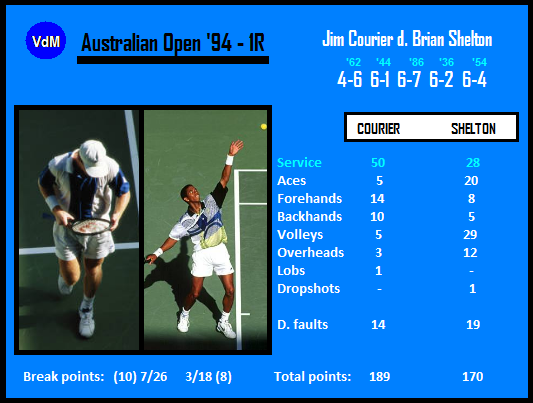
Points won by each set: | 38-42, 36-25, 52-54, 28-16, 35-33 |
Points won directly behind the serve:
29 % Courier – 55 of 188
28 % Shelton – 48 of 171
The first day of the Aussie Open ’94, Centre Court, their only meeting, and a match which lasted 4 hours 42 minutes – for another 14 days of the event no pair of players would play longer. Courier [3] – among the elite players born in the 70s – was playing in the slowest pace on serve, already after the first two points of the match he needed 27 seconds to deliver another serve (!) despite the 20-second rule obligating at Slams since the beginning of the 90s decade. ☆ Shelton [99] was never an easy opponent for the top players, but it was unlikely that the two-time defending champion Courier would face such a predicament, even though he lost his charm of the best player in the world in the last quarter of the 1993 season. Against Shelton he needed to produce his biggest comeback as far as 5th sets are concerned, Courier trailed *1:3 (0/40) in the decider. The match featured an exaggerated number of double faults, they committed them due to different reasons: Shelton had to risk his second serve being aware of the quality of Courier’s returns and passing-shots while Courier knew that Shelton loved applying the chip-and-charge strategy, thus the second serves should have been deep enough to disrupt Shelton’s mindset. Courier committed the most double faults in his career, but he also forced plenty of Shelton’s return errors with his second serves. The underdog dealt better with tighter situations in sets 1 and 3 – in the opener he broke Courier at 4-all facing a game point, at 4-all in the mid-set he withstood four mini-set points in the longest game of the match (six deuces). Shelton was six points away from winning the match at 4-all (deuce) in the decider after two forehand-return winners in a row. In the last game of the match he was 0/40 when saved two match points, the second one with a second serve ace. On the third match point he proposed a kick-serve, but Courier responded with a tight BH-return, Shelton dived, yet he didn’t reach the ball. It was an interesting match also from a technological point of view, a confrontation of head-sizes at opposite poles (Shelton’s Spalding “Assault” 110 sq vs Courier’s Wilson “Pro Staff” 85 sq). Courier easily won four more matches, but in the semifinals he had no chance against Sampras.
☆ Bryan Shelton won only two minor titles in his career (both in Newport), he never achieved a good result at the Mercedes Super 9 level, never cracked the Top 50, but somehow he was able to play his best tennis at Slams on the biggest arenas facing the top players. His good result against Courier wasn’t accidental, here are all examples:
US Open ’89: Connors 7-6, 2-6, 2-6, 2-6
Wimbledon ’90: Lendl 6-7, 7-6, 4-6, 4-6
US Open ’91: Edberg 4-6, 6-2, 6-7, 1-6
Wimbledon ’92: Becker 4-6, 6-3, 6-7, 6-7
Aussie Open ’94: Courier 6-4, 1-6, 7-6, 2-6, 4-6
Wimbledon ’94: Stich 6-3, 6-3, 6-4 !
He was a classical serve-and-volleyer primarily, but he didn’t technically struggle with his ground-strokes;
he won two Challenger clay-court titles, and remains some sort of an underachiever